

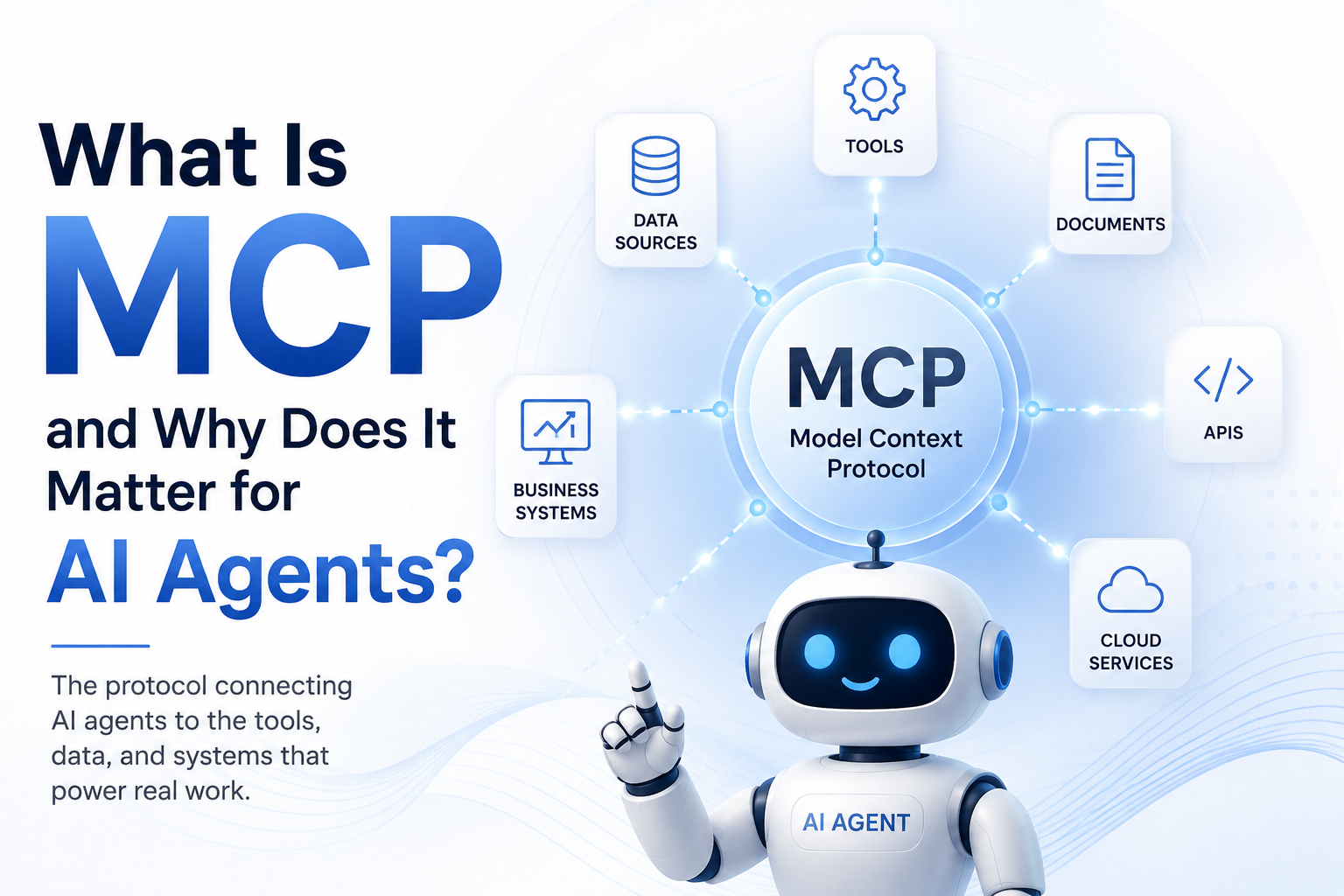
Model Context Protocol (MCP) is an open standard that gives AI applications a consistent way to connect with external tools, data, and services. For AI agents, that matters because intelligence alone is not enough: an agent needs access to the systems where real business work happens.
An AI model might understand a request perfectly. But if it cannot retrieve the relevant customer record, access an approved knowledge source, check a database, or interact with a business application, its ability to act remains limited.
MCP helps address this connectivity problem.
Instead of building a different custom integration every time an AI application needs to interact with another system, MCP provides a standardized interface for exposing tools and context to AI applications.
For organizations building AI agents, this can make the difference between an isolated AI assistant and an agent that can participate in real business workflows.
Quick Answer: What Is MCP?
MCP stands for Model Context Protocol. It is an open standard that enables AI applications to connect to external tools, data sources, and services through a common protocol.
Think of it as a standardized connection layer between an AI application and the systems it needs to work with.
For AI agents, MCP can provide access to capabilities such as searching company information, querying databases, interacting with applications, retrieving documents, and triggering approved actions.
Why Do AI Agents Need MCP?
AI agents need access to external systems because most useful business tasks cannot be completed by a language model alone.
A model can reason about a task, but business operations live elsewhere.
Customer information may live in a CRM.
Financial information may live in an ERP.
Company knowledge may be distributed across documents and databases.
Projects may be managed in another application.
Support requests may arrive through another system.
The AI agent therefore faces a fundamental challenge:
How does it reliably connect to all the tools and information required to complete its task?
Traditionally, developers solve this by building individual integrations.
If an AI application needs access to a database, developers build a database integration.
If it needs another business system, they build another integration.
Add another tool, and another connector may be required.
As the number of models, agents, applications, and data sources increases, the integration layer can become increasingly complicated.
MCP introduces a common protocol for these interactions.
Instead of every AI application and external system requiring its own unique integration pattern, systems can expose capabilities through a standardized interface that MCP-compatible applications understand.
How Does MCP Work?
MCP works through an architecture in which an AI application connects to MCP servers that expose specific tools, resources, or capabilities.
At a high level, there are three important components.
1. MCP Host
The host is the AI application in which the user or agent operates.
It could be an AI assistant, an agentic application, a development environment, or another AI-enabled system.
The host coordinates the overall interaction.
2. MCP Client
The MCP client operates within the host and manages communication with an MCP server.
It allows the application to discover available capabilities and exchange structured requests and responses.
3. MCP Server
The MCP server exposes capabilities from an external system.
Depending on how it is designed, that could mean providing access to:
business applications,
databases,
documents,
internal knowledge,
APIs,
developer tools, or
other enterprise systems.
The result is an architecture that looks broadly like this:
User → AI Application / Agent → MCP Client → MCP Server → Business Tool or Data
The agent does not need to understand every underlying integration in the same way a developer would.
It can discover the capabilities exposed through MCP and use them according to the application's logic, permissions, and controls.
What Is an MCP Server?
An MCP server is a component that makes specific tools, data, or capabilities available to an MCP-compatible AI application.
For example, imagine a business wants an AI agent to work with its customer system.
An MCP server could expose approved capabilities such as:
search for a customer,
retrieve an account,
view an opportunity,
create a task, or
update an approved field.
The agent can discover these capabilities and call the appropriate tool when required.
Another MCP server might expose company knowledge.
Another could connect to a database.
Another might provide access to a development environment.
This modular approach is one reason MCP is relevant to agentic systems.
An agent can potentially work across multiple MCP-enabled capabilities rather than being permanently tied to one application.
What Can MCP Expose to an AI Agent?
MCP is broader than simply giving an agent a list of API calls.
Its capabilities can include mechanisms for exposing tools and contextual information to AI applications.
Tools
Tools allow an AI application to perform operations.
For example:
query a database,
retrieve a customer record,
create a support ticket,
search a system,
update information, or
trigger a workflow.
This is particularly important for AI agents because tools allow them to move from generating answers to participating in actions.
Resources
Resources provide contextual information that an application can use.
These might include documents, files, database content, or other information required to complete a task.
Prompts and Other Capabilities
MCP can also provide reusable interaction patterns and additional capabilities depending on the implementation and current protocol specification.
Together, these mechanisms create a standardized way for AI applications to discover and use external capabilities.
Why Does MCP Matter for AI Agents?
MCP matters because AI agents become significantly more useful when they can securely access the right context and take appropriate actions across business systems.
This is part of the broader shift from copilots to AI-native operators - systems that do more than answer questions and can participate directly in business workflows.
Consider the difference between two AI systems.
The first can answer:
"How should I respond to this customer?"
The second can potentially:
identify the customer,
retrieve their account history,
check the relevant order,
consult company policy,
determine an appropriate next step,
prepare the response,
update the relevant system, and
escalate the issue if approval is required.
The second system is no longer functioning merely as a chatbot.
It is participating in a workflow.
For that to happen reliably, the agent needs an integration layer between its reasoning capabilities and the systems where business information and actions exist.
MCP is emerging as one important standard for creating that layer.
What Problem Does MCP Solve?
MCP helps reduce the need for fragmented, one-off integrations between AI applications and external systems.
Imagine an organization experimenting with several AI applications.
Each application may need access to:
CRM data,
company documents,
databases,
project-management tools,
internal APIs, and
other business systems.
Without standardization, each combination can require custom integration work.
That creates several challenges.
Integration Complexity
Every new model, agent, or business tool can introduce additional integration work.
Maintenance
Custom integrations must be maintained as APIs, applications, authentication methods, and AI architectures evolve.
Portability
An integration designed specifically for one AI application may not transfer easily to another.
Scaling
A few custom integrations can be manageable.
Dozens of agents interacting with dozens of business systems are a very different architectural challenge.
MCP does not eliminate integration engineering. The underlying business systems still need to be connected and governed correctly.
What it can do is provide a common interface at the AI layer, reducing unnecessary duplication.
MCP vs APIs: What's the Difference?
MCP does not replace APIs. It provides a standardized way for AI applications to discover and interact with capabilities that may themselves be implemented using APIs.
An API defines how software interacts with a particular service.
For example, a CRM API might define how an application retrieves customer information.
MCP sits at a different layer.
An MCP server could wrap that CRM API and expose selected capabilities in a form an MCP-compatible AI application can discover and use.
A useful way to think about it is:
API: How software talks to a particular service.
MCP: A common way AI applications discover and use external capabilities.
The two can work together.
MCP standardizes the agent-facing interface while APIs can continue handling the underlying system interactions.
MCP vs Function Calling: What's the Difference?
Function calling allows a model to request a specific function or tool, while MCP standardizes how external capabilities can be exposed and discovered across compatible AI applications.
Function calling is an important building block for agentic systems.
A developer might define functions such as:
find_customer
check_inventory
create_ticket
The model can determine when one of those functions should be invoked.
MCP addresses a broader integration challenge.
Instead of defining every tool directly inside each AI application, an MCP server can expose capabilities through a common protocol.
This can make tools more reusable across MCP-compatible environments.
Function calling and MCP are therefore not necessarily competing approaches.
An agentic architecture can involve both tool calling and MCP-based connectivity.
MCP vs RAG: Are They the Same?
No. MCP and Retrieval-Augmented Generation (RAG) solve different problems, although they can work together.
RAG primarily helps an AI system retrieve relevant information from an external knowledge source before generating an answer.
For example, a company might use RAG to help an assistant answer questions based on internal policies.
MCP is a broader connectivity protocol.
It can enable AI applications to access information and interact with tools or services.
The distinction can be simplified as:
RAG: "Find the information I need to answer."
MCP: "Connect me to the external capabilities I may need."
An agent could use both.
It might retrieve relevant company knowledge and then use an MCP-connected tool to perform an approved action.
A Practical MCP Example
Imagine a company builds an AI sales operations agent.
A sales manager asks:
"Which enterprise opportunities have had no activity for 30 days? Review them and create follow-up tasks for the account owners."
To complete this request, the agent needs more than language generation.
It needs to:
access opportunity data,
identify the relevant records,
inspect recent activity,
determine which opportunities meet the criteria,
identify the account owners,
create appropriate follow-up tasks, and
report what it did.
An MCP-enabled architecture could expose approved CRM capabilities to the agent.
The agent can then reason about the request while using external tools for the actual business data and actions.
Conceptually:
Manager Request
↓
AI Agent
↓
Understand Objective
↓
Discover Available MCP Tools
↓
Retrieve CRM Data
↓
Analyze Opportunities
↓
Create Approved Tasks
↓
Return Results
That is much closer to an operational AI system than a standalone chatbot.
Why MCP Matters for Enterprise AI
The significance of MCP becomes clearer as organizations move from individual AI assistants toward networks of AI agents and business systems.
It Can Reduce Integration Fragmentation
A standardized protocol can reduce the need to design every agent-to-system connection from scratch.
It Supports More Capable Agents
Agents become more useful when they can access current information and interact with real systems.
It Can Improve Portability
Standardized interfaces can make it easier to reuse capabilities across compatible AI applications rather than locking every integration into one architecture.
It Separates Intelligence From Integrations
The model or agent can focus on interpreting objectives and selecting actions, while MCP servers expose the capabilities needed to interact with external systems.
This separation can make agent architectures more modular.
It Supports an Expanding Agent Ecosystem
As MCP adoption grows across AI platforms and development environments, businesses can potentially build reusable capability layers instead of repeatedly rebuilding the same integrations.
For enterprises, that may become increasingly important as AI moves from experimentation into production workflows.
Is MCP Secure?
MCP can be part of a secure AI architecture, but using MCP does not automatically make an AI agent secure.
This distinction is critical.
Connecting an AI agent to business tools increases its capabilities.
It also increases the consequences of mistakes.
Consider an agent with access to a CRM.
Should it be allowed to read every customer?
Can it change account information?
Can it delete records?
Can it export customer data?
Should some actions require human approval?
The same questions apply to financial systems, internal databases, communication platforms, developer tools, and other enterprise applications.
Organizations therefore need controls around:
authentication,
authorization,
least-privilege access,
credential management,
tool permissions,
data access,
human approval,
logging,
monitoring,
auditability, and
trusted MCP servers.
The principle should be straightforward:
An AI agent should have access only to the data and actions required for its role.
For sensitive operations, businesses should also consider human-in-the-loop approval before actions are executed.
Does Every AI Agent Need MCP?
No. MCP is useful, but not every AI agent requires it.
A simple internal assistant working with one fixed data source may be adequately served by a direct integration.
Similarly, an agent built for a tightly constrained workflow might use existing APIs or tools without benefiting significantly from an additional protocol layer.
MCP becomes particularly interesting when:
an agent needs multiple external tools,
several agents need access to common capabilities,
organizations want reusable integrations,
AI applications may change over time,
agents need to discover available tools dynamically, or
the business is developing a broader agentic architecture.
The decision should therefore be architectural rather than trend-driven.
Use MCP where standardization creates genuine value.
What Should Businesses Consider Before Adopting MCP?
Before introducing MCP into an enterprise AI architecture, start with the business workflow.
Ask:
What Does the Agent Actually Need to Do?
Define the business objective before selecting the integration technology.
Which Systems Does It Need?
Identify the minimum data sources, applications, and actions required.
What Should Be Read-Only?
Not every connection needs action permissions.
Giving an agent read access is very different from allowing it to modify business records.
Which Actions Need Human Approval?
High-impact actions should have appropriate approval and escalation mechanisms.
Who Owns the MCP Servers?
Businesses need clear ownership for maintaining, securing, monitoring, and updating integrations.
What Happens When Something Fails?
Production systems need predictable error handling, logging, observability, and recovery mechanisms.
MCP can standardize connectivity.
It does not remove the need for sound system architecture and governance.
What Is the Future of MCP and AI Agents?
MCP is developing quickly alongside the broader shift toward agentic AI.
Its importance is not simply technical.
It reflects a larger change in how AI systems are being designed.
The first generation of enterprise generative AI largely focused on:
Ask → Generate → Respond
Agentic systems introduce a more operational model:
Understand → Retrieve → Decide → Act → Verify → Escalate
For this model to work, AI needs reliable connections to the systems where business context and actions exist.
That is the role protocols such as MCP can play.
The long-term opportunity is not simply connecting more tools to chatbots.
It is creating intelligent operating systems in which AI can understand business context, access approved capabilities, coordinate work across systems, and act within clearly governed boundaries.
What Does MCP Mean for Your AI Strategy?
MCP matters because the value of an AI agent increasingly depends on what it can securely connect to and accomplish—not only on how intelligent the underlying model is.
A powerful model isolated from your business systems remains limited.
Connect that intelligence to the right knowledge, tools, applications, and workflows, and it can become part of how work actually gets done.
But connectivity should not be confused with autonomy.
The goal is not to give AI unrestricted access to every system.
The goal is to design an architecture in which the agent has the right context, the right tools, the right permissions, and the right human oversight for the job it needs to perform.
MCP provides an increasingly important standard for creating those connections.
For organizations exploring AI agents, the strategic question is therefore moving beyond:
"Which AI model should we use?"
toward:
"How will our AI securely interact with the systems, knowledge, and workflows that run our business?"
At IrizPro, we design AI systems around real business operations—from agentic workflows and knowledge systems to integrations that connect intelligence with action.
If you're exploring how AI agents could operate across your business systems, the starting point is not simply choosing a model. It is designing the architecture, context, permissions, tools, and workflows that allow AI to create measurable business value.
Explore AI Engineering with IrizPro and turn isolated AI capabilities into connected, intelligent operations.