

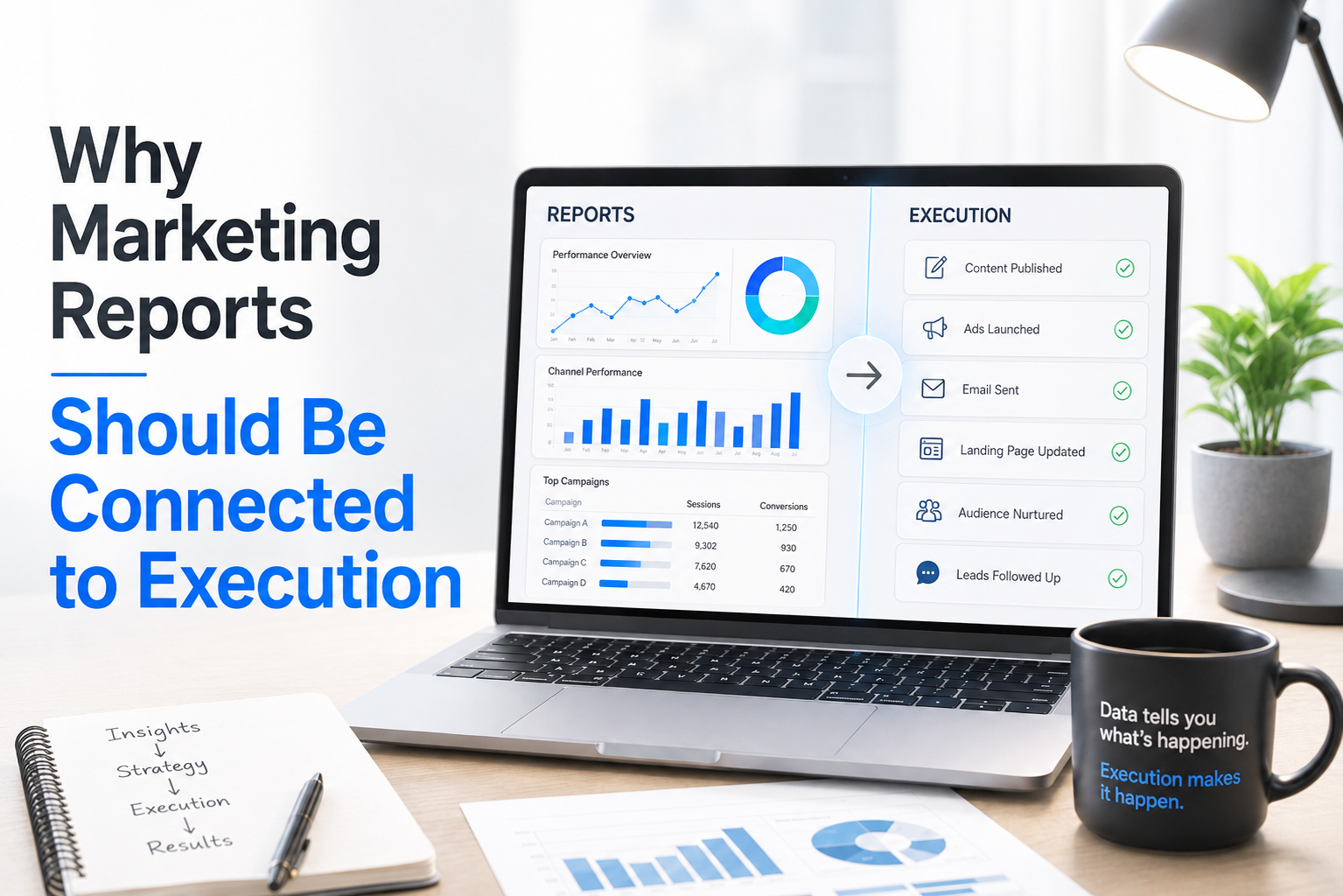
Most businesses create marketing reports.
But not every business uses those reports to improve execution.
A report may show campaign performance, lead numbers, website traffic, social media reach, ad spend, conversions, or content activity. But if the report is disconnected from daily marketing workflows, it often becomes a document people review after the work is already done.
That is the problem.
Marketing reports should not only explain what happened.
They should help teams decide what to do next.
In modern marketing, reporting and execution need to work together.
The Problem with Traditional Marketing Reports
Traditional marketing reports are usually created at the end of a week, month, or campaign.
They answer questions like:
How many leads came in?
Which campaign performed best?
What was the cost per lead?
How many posts were published?
How much website traffic came in?
Which channel gave better engagement?
These are useful questions. But they are not enough.
If a report only gives numbers without connecting them to tasks, ownership, follow-ups, content status, and campaign actions, it does not improve execution.
Traditional Reporting Problem | Business Impact |
Reports are prepared after campaigns end | Teams react late |
Data is collected manually | Reporting becomes time-consuming |
Metrics are disconnected from workflows | Insights do not become action |
Leads are reported but not tracked properly | Follow-ups get missed |
Content performance is shown separately | Planning does not improve |
Reports sit in PDFs or sheets | Teams do not use them daily |
This is why many businesses have reports but still lack marketing clarity.
Why Execution Matters More Than Reporting Alone
Marketing is not only about measuring activity. It is about improving movement.
A lead should move from inquiry to qualification to follow-up.
A campaign should move from idea to launch to optimization.
A content plan should move from draft to approval to publishing.
A report should move from data to decision to action.
If marketing reports are not connected to these execution stages, they become passive.
Google’s Think with Google highlighted the “actionability gap” in marketing measurement: while 87% of respondents said marketing mix modeling was important for gaining data-driven insights, only 28% said their organization was very effective at converting those insights into timely action. Google’s article also noted that data quality and integrating siloed data from multiple sources are major challenges when converting insights into action.
This is the core issue for many businesses.
They do not lack data.
They lack execution connected to data.
Reporting Should Answer “What Next?”
A strong marketing report should not stop at performance numbers.
It should answer:
What needs attention?
Which leads need follow-up?
Which campaigns need optimization?
Which content topics are working?
Which platform is underperforming?
Which team member owns the next step?
Which tasks are delayed?
What should be changed this week?
This moves reporting from a review activity to an execution tool.
Report Metric | Execution Question |
Leads generated | Which leads need follow-up today? |
Cost per lead | Which campaign needs budget adjustment? |
Content engagement | Which topic should we create more of? |
Website traffic | Which page needs better CTA or lead capture? |
WhatsApp inquiries | Which conversations are pending response? |
LinkedIn performance | Which post format should be repeated? |
Blog performance | Which keyword cluster needs more content? |
The real value of reporting is not the number.
The real value is the decision that follows the number.
Why Disconnected Reporting Slows Marketing Teams
Disconnected reporting creates multiple problems.
The marketing team may have data in one place, content plans in another place, leads in another tool, and approvals happening through messages.
This makes execution difficult.
For example:
The report says leads increased, but no one knows how many were followed up.
The report says LinkedIn engagement improved, but the content calendar is not updated.
The report says website traffic increased, but the landing page CTA remains weak.
The report says campaign cost is rising, but the ad creative is not changed.
The report says blogs are performing well, but no one plans the next SEO cluster.
When reporting and execution are separate, insights are delayed and opportunities are missed.
Modern Marketing Needs Connected Visibility
Marketing today runs across many channels: websites, blogs, LinkedIn, WhatsApp, email, ads, CRM, SEO, and social media.
Because of this complexity, teams need connected visibility.
Salesforce’s Tenth Edition State of Marketing report is based on insights from nearly 4,500 marketers worldwide and highlights AI, data, personalization, and agentic marketing as major themes. It also notes that while 83% of marketers recognize the shift toward personalized, two-way messaging, only one in four are satisfied with how they use data to power those moments. (Salesforce)
That gap matters because marketing execution depends on the ability to use data at the right time.
Connected marketing reporting helps teams see:
What is planned
What is pending
What is published
What is generating leads
What needs follow-up
What is underperforming
What action should happen next
This turns reporting into a live operating layer, not just a monthly summary.
Reporting Connected to Execution: What It Looks Like
Marketing Area | Disconnected Reporting | Connected Execution Reporting |
Campaigns | Shows spend and leads after campaign ends | Shows active performance and optimization actions |
Leads | Shows total leads generated | Shows lead status, source, follow-up stage, and owner |
Content | Shows posts published | Shows planned, drafted, approved, published, and pending content |
Shows inquiry count manually | Shows pending replies, follow-ups, and conversion movement | |
SEO blogs | Shows traffic and rankings | Connects keywords, publishing status, and next content actions |
Reporting | Prepared manually | Updated through connected workflows and dashboards |
The difference is simple.
Disconnected reports tell you what happened.
Connected reports help you improve what happens next.
The Role of AI in Marketing Reporting
AI can make marketing reporting more useful when it is connected to workflows.
Instead of only showing charts, AI can help summarize performance, identify patterns, highlight delays, recommend next steps, and reduce manual reporting effort.
HubSpot’s 2026 State of Marketing report says it surveyed more than 1,500 global marketers and found that 68.2% of marketers say they understand how to use AI in marketing, while 67.5% say they know how to measure AI impact. The same report also says 86.4% of marketers now use AI tools, especially for content and media creation, and recommends starting with repetitive tasks before expanding into reporting and strategy. (HubSpot Blog)
For marketing teams, this means AI can support reporting in practical ways:
AI Reporting Use Case | Business Benefit |
Summarizing weekly marketing activity | Saves reporting time |
Identifying delayed tasks | Improves accountability |
Highlighting underperforming campaigns | Helps faster optimization |
Analyzing lead sources | Supports better budget decisions |
Generating content performance insights | Improves content planning |
Creating next-step recommendations | Turns reporting into action |
AI should not replace marketing judgment.
It should reduce manual effort and help teams act faster.
Why Business Owners Need Execution-Linked Reports
Business owners usually do not need more dashboards.
They need answers.
They want to know:
Are leads being followed up?
Are campaigns improving?
Are teams executing consistently?
Are we spending on the right channels?
What is pending?
What needs attention?
What should we do next?
A report that only shows numbers may not answer these questions.
A connected marketing report shows both performance and execution status.
Business Question | Connected Report Should Show |
Are we getting leads? | Lead volume by source |
Are leads being handled? | Follow-up status and owner |
Is content going out regularly? | Content calendar and publishing status |
Are campaigns improving? | Performance trend and optimization notes |
What is stuck? | Pending approvals, delayed tasks, missed follow-ups |
What should we do next? | Recommended actions |
This is what makes reporting operationally useful.
How to Connect Marketing Reports with Execution
Businesses can start with a simple framework.
1. Define the decision behind every report
Do not create reports just because data is available. Every report should support a decision.
2. Connect metrics to workflow stages
Lead numbers should connect to follow-up stages. Content performance should connect to future planning. Campaign spend should connect to optimization actions.
3. Track ownership
Every important insight should have an owner. Without ownership, insights remain passive.
4. Reduce manual reporting
Use dashboards, CRM workflows, automation, and AI summaries where possible.
5. Review reports frequently
Marketing reports should guide weekly action, not only monthly review.
6. Close the loop
After action is taken, the next report should show whether that action improved performance.
How cMOS Helps
For businesses managing marketing through scattered tools, reports often become disconnected from execution.
cMOS by Irizpro is designed to help businesses bring marketing workflows, leads, follow-ups, content planning, SEO blog workflows, campaign tracking, and reporting into one connected system.
With cMOS, the aim is not only to show marketing activity.
The aim is to make execution more visible, structured, and trackable.
That means teams can understand what is planned, what is pending, what is published, what needs follow-up, and what action should happen next.