

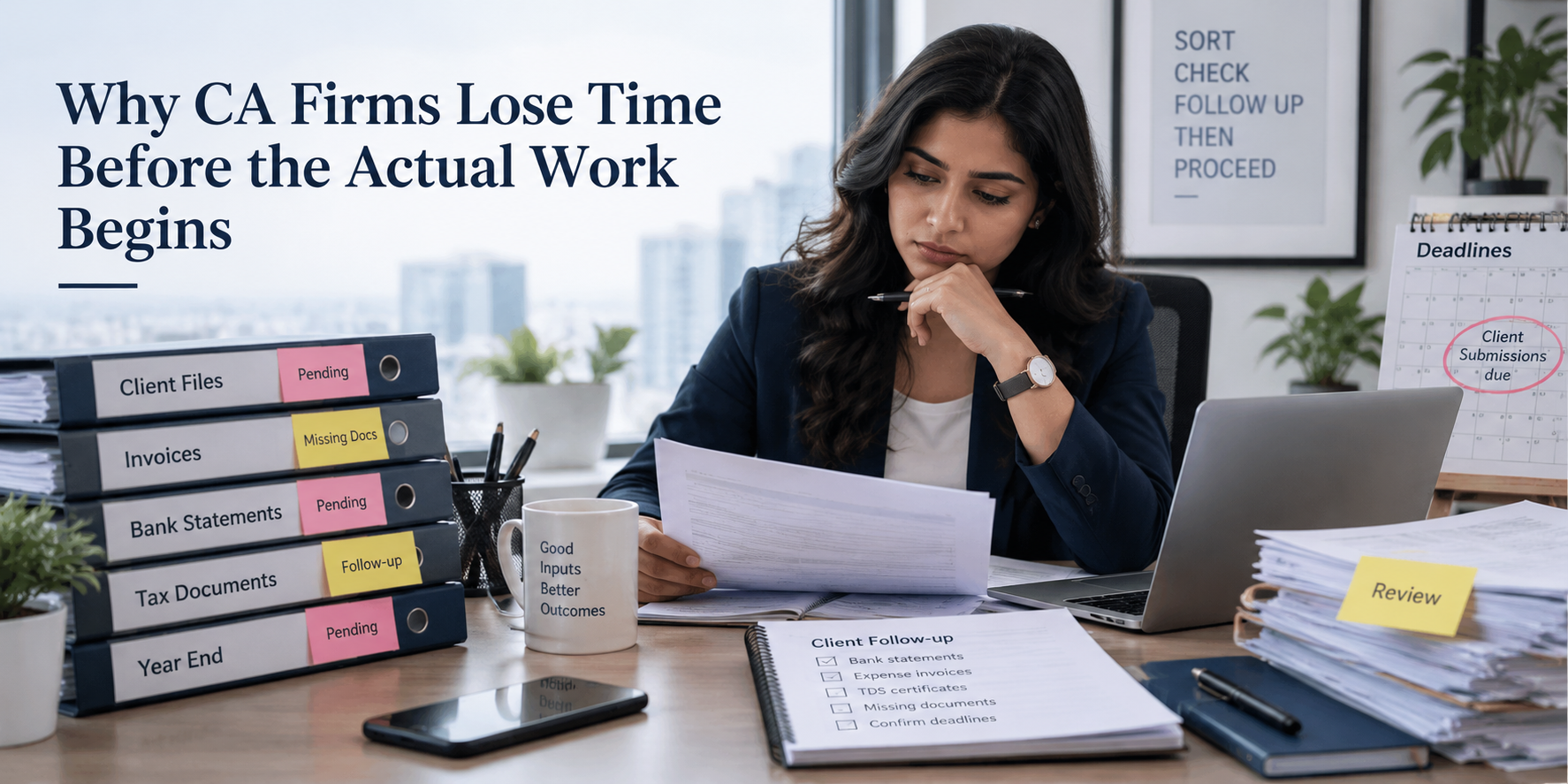
Most CA firms do not lose time because their teams do not know the work.
They lose time before the actual work even begins.
Before the reconciliation starts, before the audit file is reviewed, before the GST return is prepared, before the financial statements are checked, and before the partner opens the final working paper, there is usually a long period of waiting, chasing, sorting, renaming, checking, and clarifying.
The client has sent some invoices on email, some on WhatsApp, a few in PDF, a few as photos, one Excel file with missing columns, and another folder named “final latest updated new.” The team knows the work, but the work cannot start properly because the inputs are not ready.
This is the hidden productivity problem inside many CA firms.
The actual accounting, audit, tax, or compliance work may take a certain number of hours. But the preparation around that work often takes much longer than anyone tracks.
And because this delay feels normal, firms rarely measure it.
CA Firms Are Not Short of Skill. They Are Short of Clean Inputs.
A CA firm is built around expertise: accounting standards, taxation, compliance, audit procedures, documentation, financial judgment, and client advisory.
But expertise becomes difficult to apply when the team spends too much time simply getting the basic material in order.
The problem is not always technical. It is operational.
A junior team member waits for missing documents. A senior has to ask whether the latest file is really the latest version. The client sends clarification in a message thread, but the supporting document is in email. The audit checklist is updated, but the client has not responded to three open points. The partner asks for a status update, and the team spends time preparing the status instead of moving the work forward.
This is where time disappears.
Not in one big mistake.
But in hundreds of small interruptions.
Where the Time Actually Goes
Before the Actual Work | What Usually Happens | Why It Delays the Team |
|---|---|---|
Document collection | Files arrive through email, WhatsApp, shared drives, and physical copies | The team spends time finding and consolidating documents |
File naming | Clients send unclear or duplicate file names | Staff must open files manually to understand what they contain |
Version control | Multiple “final” versions are shared | Seniors are unsure which version should be reviewed |
Missing information | Bank statements, invoices, confirmations, or ledgers are incomplete | Work starts, stops, and restarts repeatedly |
Client clarification | Questions are asked across different channels | Context gets lost and follow-ups become repetitive |
Internal allocation | Work is assigned manually or informally | Responsibility is unclear and deadlines slip |
Review preparation | Working papers are incomplete or poorly organized | Seniors and partners spend extra time before actual review |
This table shows why the issue is not only about doing the work faster.
The issue is making the work ready faster.
The Chasing Problem Is Bigger Than Firms Admit
Every CA office knows this routine.
“Please send the pending invoices.”
“Please share the bank statement.”
“Please confirm which file is final.”
“Please send the signed document.”
“Please clarify this transaction.”
“Please upload the supporting details.”
“Please send the missing GST data.”
These messages look small, but they create a heavy operational load.
The problem becomes worse during peak periods, when the same staff member is handling multiple clients, multiple deadlines, and multiple pending lists. A client may not respond immediately, so the team follows up again. Another client responds, but sends the wrong file. A third client sends the data, but not in the required format.
By the time the actual work begins, the team is already under pressure.
This is why CA firms often feel busy even before the real professional work starts.
The Cost of Poor Preparation
The delay before work begins has a direct impact on the firm’s productivity, quality, and client experience.
Problem | Impact on the Firm |
|---|---|
Documents arrive late | Filing and review timelines become compressed |
Data is incomplete | Teams repeat the same work after corrections |
Files are scattered | Staff spends time searching instead of analyzing |
Status is unclear | Seniors interrupt juniors for updates |
Clients are chased manually | Relationship managers and staff lose productive hours |
Review files are not standardized | Partners spend more time understanding the file |
Work starts without full inputs | Errors and rework increase |
This is where firms need to be honest with themselves.
A delay caused by incomplete inputs is still a workflow problem. It may start with the client, but the firm’s system must be designed to handle it better.
Why the Traditional System Breaks Down
Many CA firms still manage their workflows using a combination of Excel trackers, email folders, WhatsApp messages, desktop folders, and personal follow-up habits.
This works when the number of clients is small and the team is closely connected. But as the firm grows, the same system starts creating confusion.
The partner may not know the real status of each client. The manager may depend on the junior for updates. The junior may depend on the client for pending documents. The client may not know exactly what is pending. And because everything is spread across different channels, no one has one clean view of the work.
This is how a firm becomes dependent on memory.
And memory is not a reliable operating system.
The Work Before the Work Needs a System
Most CA firms try to improve productivity by asking teams to work faster.
But speed is not enough if the workflow itself is scattered.
The better question is not:
How do we make the team work faster?
The better question is:
How do we make sure the team starts with the right documents, the right status, and the right clarity?
That means the firm needs better systems for intake, document collection, task allocation, client follow-ups, review readiness, and partner visibility.
When this pre-work becomes structured, the actual professional work becomes smoother.
What a Better CA Workflow Should Look Like
Workflow Area | Traditional Approach | Better Approach |
|---|---|---|
Client document collection | Manual reminders and scattered attachments | Centralized document request and upload system |
Pending list tracking | Excel sheet or staff memory | Live client-wise pending tracker |
File organization | Manual folder naming | Standardized document categories |
Follow-ups | WhatsApp and email reminders | Automated reminders with clear pending items |
Task allocation | Informal assignment | Role-based task ownership |
Review readiness | Senior checks file manually | Pre-review checklist before escalation |
Partner visibility | Verbal updates or status meetings | Dashboard showing work status and blockers |
This does not mean every CA firm needs a complex enterprise system.
It means firms need a more disciplined workflow before the technical work starts.
Where AI Can Help
AI will not replace the professional judgment of a CA, and it should not be positioned that way.
But AI can reduce the operational friction around the work.
It can help classify uploaded documents, extract basic details, flag missing files, summarize client communication, generate pending lists, identify mismatches, prepare review notes, and help teams understand what is ready and what is still blocked.
For example, instead of a staff member manually checking whether all purchase invoices, bank statements, GST data, TDS details, and confirmations have been received, an AI-supported system could help prepare a client-wise readiness view.
The professional still reviews the work.
But the system reduces the time wasted before the review begins.
Practical AI Use Cases for CA Firms
Use Case | How AI Helps | Human Role |
|---|---|---|
Document sorting | Classifies invoices, statements, ledgers, confirmations, and tax documents | Verify classification and completeness |
Missing document detection | Compares received files against the checklist | Decide what is critical and follow up |
Client communication summary | Summarizes long email or WhatsApp trails | Confirm context and next action |
Review note preparation | Highlights open points and unusual items | Apply professional judgment |
Data extraction | Pulls key details from PDFs, invoices, or statements | Validate accuracy before use |
Deadline tracking | Flags clients where inputs are pending close to due dates | Prioritize and escalate |
Partner dashboard | Shows client-wise status and blockers | Make review and resource decisions |
The goal is not to make the CA less important.
The goal is to stop wasting the CA team’s time on avoidable operational friction.
The Client Experience Also Improves
Clients do not always understand why firms keep asking for documents in a particular format or by a particular date.
From the client’s side, it may feel like repeated follow-up.
From the firm’s side, it is necessary work.
A better system can make this easier for both sides. Instead of scattered messages, the client can see what is pending, what has been received, what needs correction, and what requires approval.
This makes the firm look more organized and professional.
It also reduces the emotional friction of repeated chasing.
Clients may not notice a perfectly structured internal workflow, but they definitely notice when the firm keeps asking the same thing again and again.
The Bigger Shift: From Compliance Pressure to Workflow Intelligence
CA firms are under constant deadline pressure. Compliance calendars are strict, clients respond late, regulations change, and teams are expected to manage accuracy under time constraints.
In that environment, better workflow is not a luxury.
It is a competitive advantage.
The next generation of CA firms will not be defined only by technical knowledge. Technical knowledge will remain essential, but firms will also need operational intelligence: knowing where every file is, what is pending, which client is blocking progress, which work is ready for review, and where the team is losing time.
That is where AI and automation can create real value.
Not by replacing professional expertise.
But by protecting it from unnecessary manual chaos.
Beyond Prompts Perspective
The biggest productivity leak in CA firms often begins before the actual accounting, audit, or compliance work starts.
It begins when documents are scattered, follow-ups are manual, responsibilities are unclear, and teams do not have one reliable view of readiness.
AI can help, but only when it is applied to the real workflow problem.
For CA firms, the opportunity is not simply to “use AI.”
The opportunity is to redesign the work before the work.
Because once the inputs are clean, the status is clear, and the review path is structured, the actual professional work becomes faster, more accurate, and less stressful.
Final Thought
CA firms do not only need faster accounting.
They need cleaner beginnings.
They need fewer scattered documents, fewer repeated follow-ups, fewer unclear statuses, and fewer last-minute surprises.
The future CA firm will not just be technically strong.
It will be operationally intelligent.
And that intelligence will begin before the actual work begins.