

Empty slots cost clinics time and revenue. This article gives clinic operations managers a compact playbook: exact cadences, two‑line message templates with Confirm/Reschedule buttons, a three‑step two‑way flow you can run without engineering, a consent checklist, and a brief A/B test plan to measure impact.
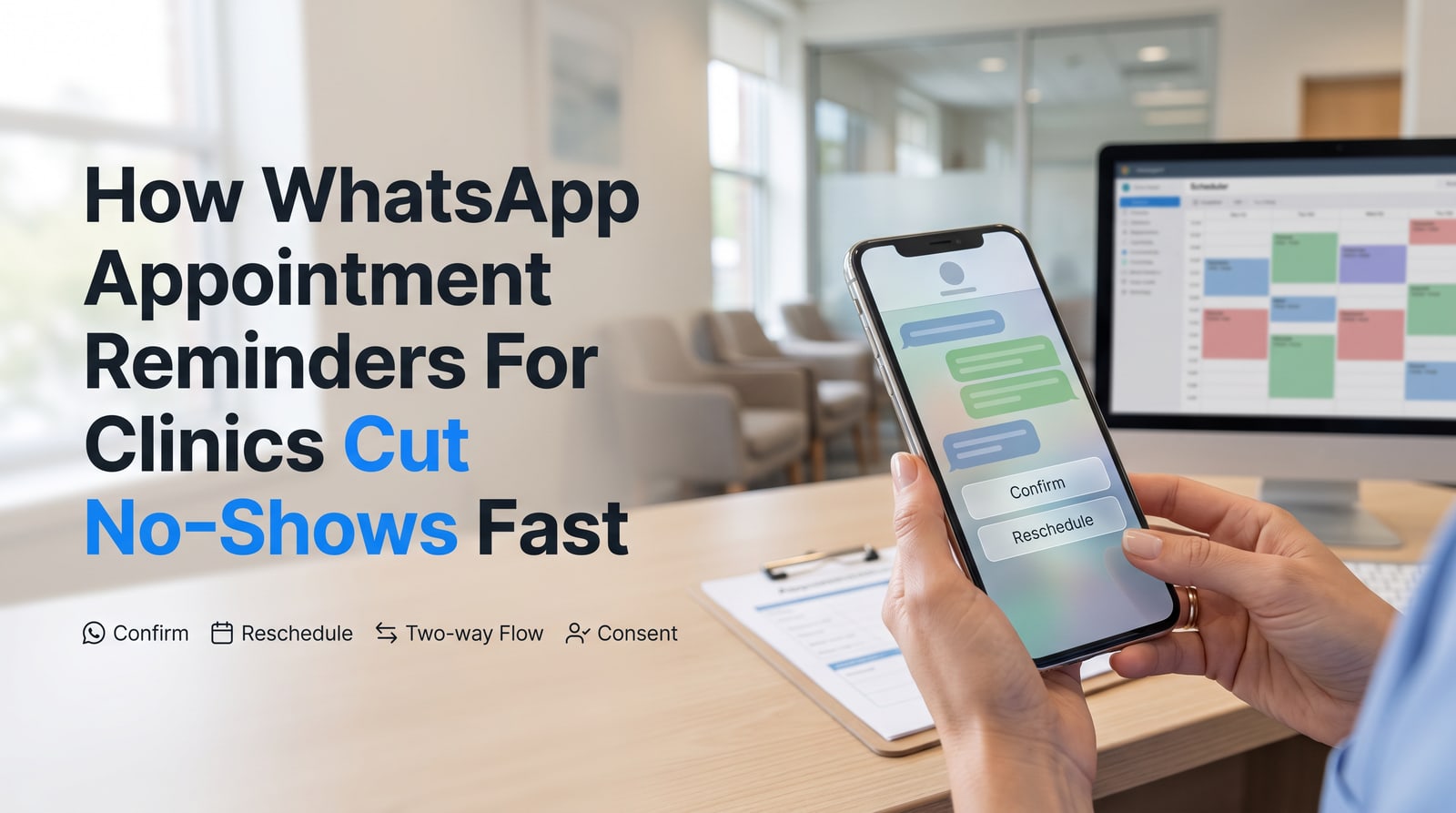
If you manage a small‑to‑medium outpatient clinic and want a low‑effort, measurable reminder workflow, these steps let you pilot WhatsApp appointment reminders quickly and measure impact during a short pilot.
Why WhatsApp Works For Clinics (Quick Evidence & What To Expect)
WhatsApp reminders work because reminders increase attendance, and interactive two‑way messages raise confirmations so staff do fewer follow‑ups. Impact varies by patient mix, appointment type and cadence.
What the research shows:
The Journal of Hospital Management and Health Policy reports a pooled 11% attendance increase from reminders: https://jhmhp.amegroups.org/article/view/10215/html
MedLaunch Health notes clinics without reminders face 15–30% no‑shows; automated reminders can cut no‑shows 40–60%: https://medlaunch.health/blogs/practice-growth/best-practices-for-appointment-reminders/
Curogram reports reminders often reduce no‑shows 20–30% and notes SMS open rates near 98%: https://curogram.com/blog/emr-integration/how-appointment-reminders-reduce-no-shows-in-clinics
Translate evidence into planning bands:
Conservative: ~11% attendance lift (pooled trials).
Typical: ~20–30% reduction in no‑shows.
Optimistic: 40–60% reductions in high‑baseline clinics using multi‑touch automation.
WhatsApp Appointment Reminders For Clinics — Recommended Cadence & Message Design
A clear cadence plus short, button‑driven messages increases replies and reduces manual calls.
Three practical cadences (copy‑paste)
Cadence | Timing | Example message (two-line) | Primary action expected |
|---|---|---|---|
Basic | two reminders in the days before | "Dr. Patel — appointment Thu 14:00. [Confirm] [Reschedule]" | Confirm or request new slot |
Standard | 72h, 24h, 2h before | "Dr. Patel — appointment Thu 14:00. [Confirm] [Reschedule]" | Confirm or reschedule (recommended) |
Aggressive | an advance reminder well before the visit, plus two closer reminders | "Reminder: Thu 14:00 with Dr. Patel. [I’m coming] [Reschedule]" | Capture hard-to-reach patients quickly |
MedLaunch’s three‑reminder finding supports the Standard cadence as the default for most clinics: 72h, 24h, then 2h before the visit.
Message design tips that increase replies:
Put purpose first: who/when on line one; buttons on line two.
Keep to two lines and offer 1‑click Confirm plus Reschedule.
Include one simple prep note when needed ("Bring blood work").
A/B test button labels ("Confirm" vs "I’m coming") and short vs slightly longer copy.
Two‑Way Flows & Simple Operational Setup (No Engineering Required)
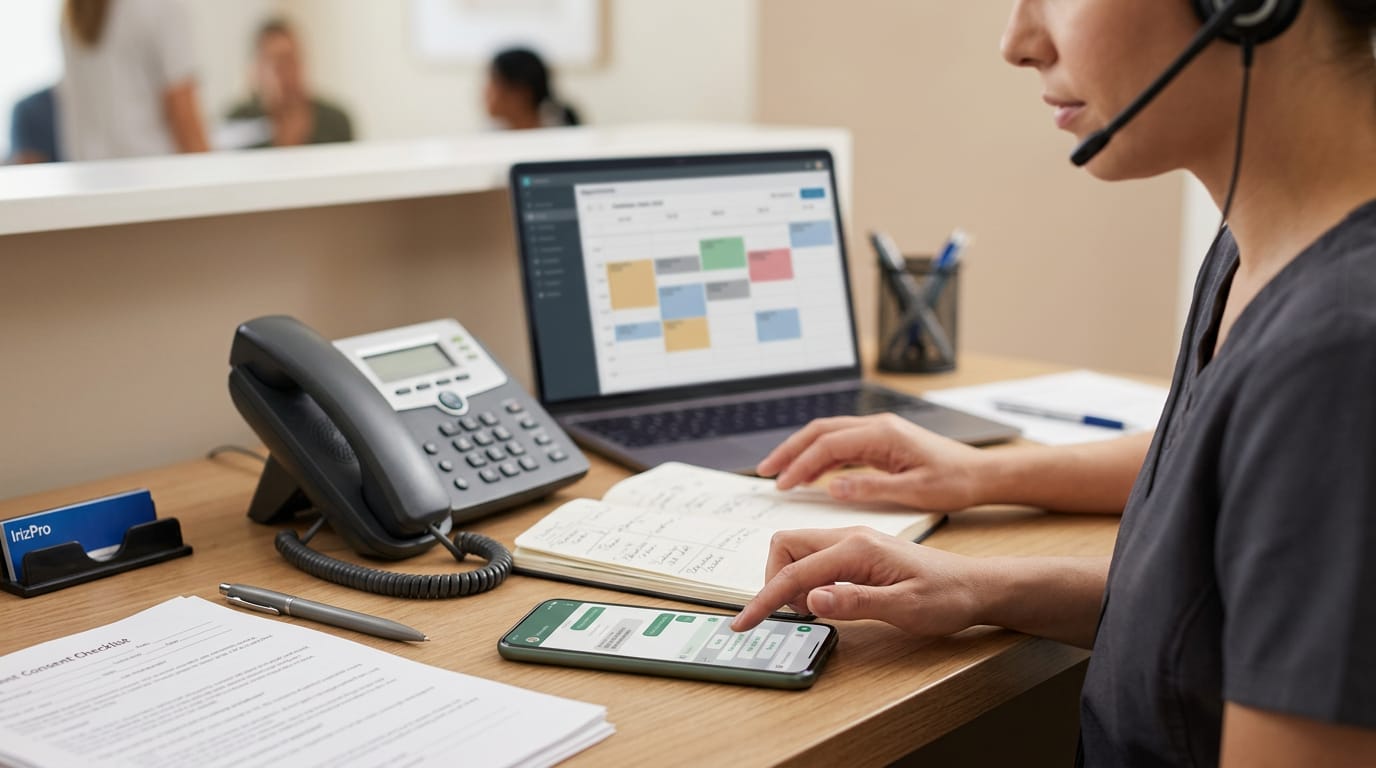
You can capture confirmations and reschedules with a light automation platform or a Business API partner; full EMR sync is optional.
The 3-step two-way playbook for reception teams:
Send an interactive reminder with Confirm and Reschedule buttons.
If Confirm clicked → mark appointment confirmed in scheduler.
If Reschedule clicked → send an available‑slots link or flag for callback.
Fallback: if no confirmation after the final reminder, trigger a single front‑desk call.
Implementation choices:
Plug‑and‑play automation: fastest to launch, staff trains on a dashboard.
Business API partner: supports interactive templates and larger volumes.
Minimal EMR sync: reduces duplicate work but needs IT time.
For implementation patterns and automation ideas, see IrizPro’s examples: https://irizpro.com/insights/10-whatsapp-automation-ideas-to-save-your-team-time
Compliance & Consent Checklist Clinics Can Use
Keep consent simple, documented and accessible to scheduling staff to reduce legal risk.
Copy‑ready consent line (registration) "I agree to receive appointment reminders on WhatsApp for my visits and understand I can opt out any time." Have patients initial or tick and record the WhatsApp number.
Quick country notes & storage practices:
India: follow local messaging rules and retain consent records; check vendor terms for templates.
U.S. HIPAA: ensure vendors sign Business Associate Agreements and use secure systems.
Store consent in the patient file, limit access, and set a retention period reviewed by legal/compliance.
Practical privacy/process notes: https://irizpro.com/privacy-policy
Quick A/B Test Plan + Measuring Impact (Keep it short)
Run a focused short test to find better timing and button copy without disrupting operations.
What to vary and sample KPIs:
Vary timing (72h vs 48h), CTA text ("Confirm" vs "I’m coming"), and prep instructions.
Track Confirm Rate, Reschedule Rate, No‑Show Rate.
Decision rule: winner = higher Confirm Rate and lower No‑Show Rate over the test period.
Worked evidence summary:
Scenario | Evidence source | Typical improvement note |
|---|---|---|
Conservative | ~11% attendance increase baseline | |
Typical | https://curogram.com/blog/emr-integration/how-appointment-reminders-reduce-no-shows-in-clinics | Plan 20–30% no‑show reduction |
Optimistic | https://medlaunch.health/blogs/practice-growth/best-practices-for-appointment-reminders/ | 40–60% reductions possible with full automation |
Start small, measure Confirm/Reschedule/No‑Show rates, then scale the winning cadence and copy.
Frequently Asked Questions
Are text appointment reminders HIPAA compliant?
They can be if you document patient consent, use secure vendors and sign necessary agreements; check with your legal/compliance team before starting. For privacy-process examples see IrizPro's privacy policy.
How can WhatsApp be used in the healthcare industry?
WhatsApp suits appointment reminders, confirmations, short pre‑visit instructions and basic triage when paired with two‑way quick replies and clear consent. Keep clinical advice minimal and escalate complex cases by phone.
How do I set up automatic reminders in WhatsApp without heavy engineering?
Use an automation platform or Business API partner that supports interactive messages and connects to your scheduler, then apply the 3‑step two‑way playbook above. See implementation patterns at IrizPro insights.
What reminder cadence works best for clinics?
A three‑touch cadence (72 hours, 24 hours and 2 hours before) is widely recommended; choose a basic or aggressive variation depending on patient mix and appointment urgency (MedLaunch).
Conclusion
WhatsApp appointment reminders for clinics are a low‑effort way to reduce no‑shows and recover booked visits. Start with a three‑touch cadence and short two‑line messages with Confirm/Reschedule buttons, use the three‑step two‑way playbook to update your scheduler, and run a short A/B test tracking Confirm/Reschedule/No‑Show rates. For help choosing an implementation path or piloting a flow, contact IrizPro: https://irizpro.com/contact. With clear consent and a short two‑way flow you can deploy improvements quickly.