
For many businesses, a website is still treated as a digital brochure.
It has a homepage, service pages, contact form, portfolio, testimonials, and basic company information. This is useful, but it is no longer enough for every business.
Customers now expect faster responses, personalized experiences, helpful content, and smoother digital journeys. At the same time, businesses want websites that do more than simply display information.
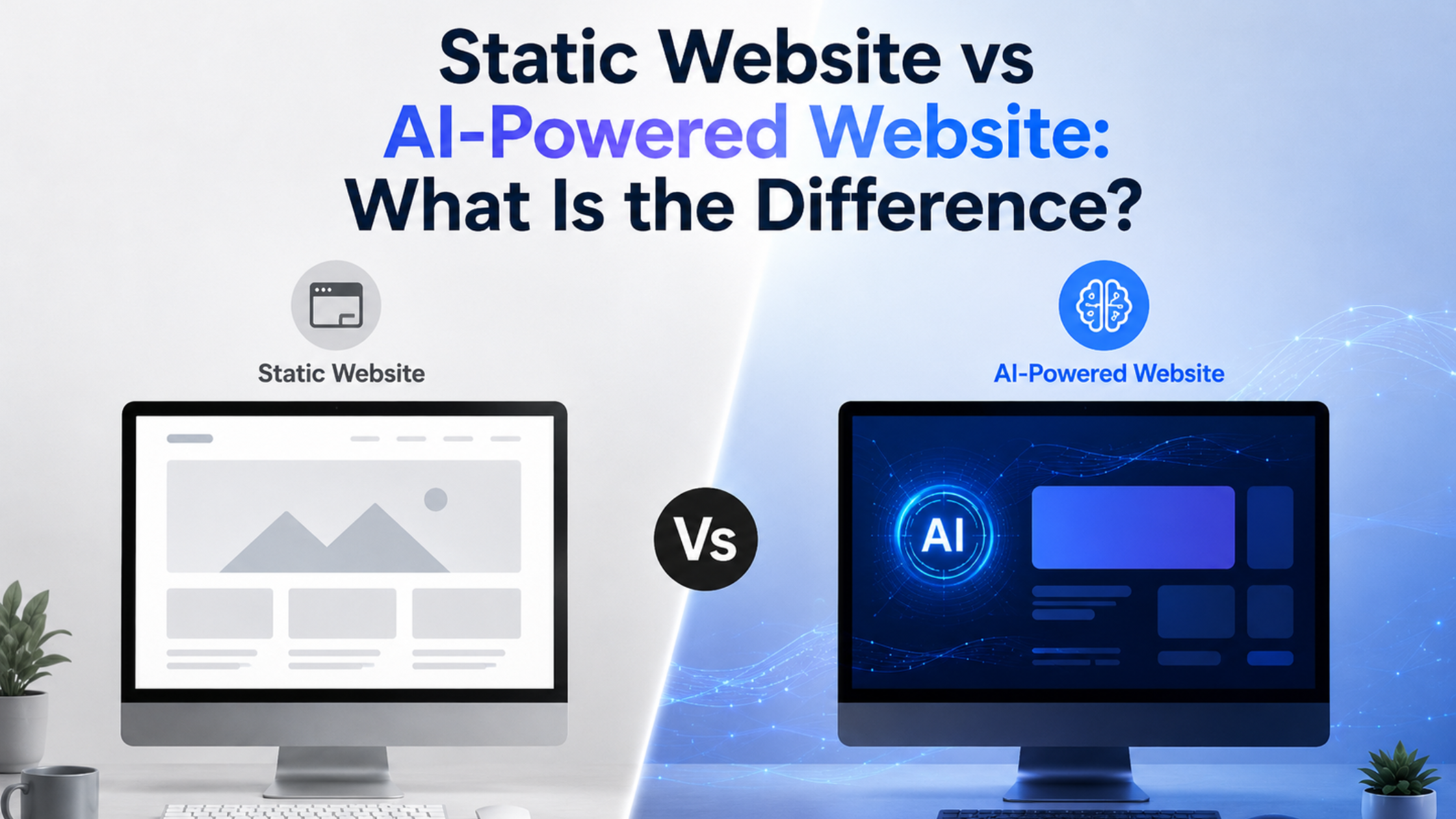
This is where the difference between a static website and an AI-powered website becomes important.
A static website mainly presents information.
An AI-powered website helps users interact, find answers, submit requirements, get guided, and trigger business workflows.
In simple terms:
A static website shows your business. An AI-powered website works for your business.
What Is a Static Website?
A static website is a website where the content is mostly fixed. Visitors can read information, browse pages, fill out a form, or contact the business manually.
Static websites are common for:
Company profiles
Portfolio websites
Brochure websites
Informational service pages
Basic landing pages
They are usually easier to build, cost-effective, and suitable for businesses that only need an online presence.
However, static websites have limitations. They do not respond intelligently to user needs. They do not qualify leads automatically. They do not personalize content. They do not connect deeply with internal workflows unless additional systems are integrated.
What Is an AI-Powered Website?
An AI-powered website uses artificial intelligence and automation to make the website more interactive, responsive, and useful for both visitors and business teams.
It may include:
AI chatbot or AI assistant
Lead qualification
Personalized recommendations
Smart forms
Automated follow-ups
AI-based search
Content suggestions
CRM integration
Workflow automation
Analytics and reporting insights
An AI-powered website is not only about adding a chatbot. The real value comes when AI is connected to business workflows.
For example, when a visitor asks about a service, the website can answer basic questions, collect requirements, qualify the lead, send the data to the sales team, trigger an email or WhatsApp follow-up, and update the CRM.
That is what makes the website intelligent.
Static Website vs AI-Powered Website: Quick Comparison
Factor | Static Website | AI-Powered Website |
Primary role | Displays information | Supports interaction and workflows |
User experience | Same for every visitor | Can be guided, personalized, and responsive |
Lead capture | Basic contact forms | Smart forms, AI chat, and lead qualification |
Response time | Depends on human follow-up | Can respond instantly to common queries |
Content updates | Manual | Can support AI-assisted content workflows |
Business workflow | Usually disconnected | Can connect with CRM, WhatsApp, email, or automation tools |
Analytics | Basic traffic and form data | Can provide deeper visitor, lead, and engagement insights |
Best for | Basic online presence | Lead generation, customer support, automation, and scaling |
Why Businesses Are Moving Beyond Static Websites
A website is no longer only a branding asset. For many businesses, it is a lead generation, customer education, sales support, and service communication channel.
Google has reported that 53% of visits are likely to be abandoned if mobile pages take longer than three seconds to load, which shows how quickly users leave when the digital experience is slow or inefficient.
Speed matters, but speed is not only about page loading. It is also about response speed, clarity, guidance, and ease of action.
If a visitor lands on a website and cannot quickly understand what to do next, the business may lose the opportunity.
An AI-powered website can help reduce this gap by guiding users faster and connecting their actions to the right business process.
Why AI-Powered Websites Matter Now
AI adoption is becoming more practical across businesses. McKinsey’s 2025 State of AI report highlights wider AI use and growing interest in agentic AI, while also noting that many organizations still face challenges in scaling impact.
Microsoft’s 2025 Work Trend Index reported that 46% of leaders say their organization is using agents to fully automate workstreams or business processes, with customer service, marketing, and product development listed among top AI investment priorities.
This is relevant for websites because the website is often the first point where business workflows begin.
A customer inquiry starts on the website.
A demo request starts on the website.
A support question starts on the website.
A product discovery journey starts on the website.
If the website is static, everything after that depends on manual follow-up.
If the website is AI-powered, the first layer of response, routing, qualification, and workflow movement can begin immediately.
Key Features of an AI-Powered Website
Feature | What It Does | Business Value |
AI Assistant | Answers common visitor questions | Reduces response delay |
Smart Lead Capture | Collects user intent and requirements | Improves lead quality |
Lead Qualification | Identifies serious inquiries | Helps sales teams prioritize |
Automated Follow-Ups | Sends reminders or next steps | Reduces missed opportunities |
Personalized Content | Shows relevant services or suggestions | Improves user engagement |
CRM Integration | Sends leads to the right system | Improves tracking |
AI Search | Helps users find information faster | Improves navigation |
Analytics Insights | Tracks behavior and patterns | Supports better decisions |
Static Website vs AI-Powered
User Action | Static Website Experience | AI-Powered Website Experience |
Visitor lands on service page | Reads information manually | Gets guided by AI assistant |
Visitor has a question | Must call, email, or fill form | Gets instant answer for common queries |
Visitor submits inquiry | Form goes to inbox | Lead is captured, categorized, and routed |
Sales follow-up | Manual and delayed | Automated alert or follow-up can be triggered |
Business reporting | Manual review of leads | Lead source, intent, and status can be tracked |
Benefits of an AI-Powered Website
1. Faster customer response
Visitors do not always want to wait for a callback. AI-powered websites can answer common questions instantly and guide users toward the next step.
2. Better lead qualification
Instead of collecting only name, phone number, and email, AI can help understand what the visitor needs, their budget, urgency, service interest, and buying intent.
3. Less manual coordination
An AI-powered website can connect inquiries to workflows, reducing dependency on manual checking, forwarding, and follow-up.
4. Better content experience
AI can support blog suggestions, FAQs, knowledge-base content, service explanations, and user-specific guidance.
5. More measurable outcomes
A smart website can help track not just visits, but intent, engagement, lead quality, and workflow progress.
PwC’s 2025 Global AI Jobs Barometer found that AI is linked to a fourfold increase in productivity growth and that workers with AI skills command a 56% wage premium, showing how AI is becoming connected with productivity and business value.
For websites, the same principle applies: AI should not be added only for appearance. It should improve productivity, speed, and business outcomes.
When Is a Static Website Enough?
A static website may be enough if:
Your business only needs basic online visibility
You do not receive many inquiries online
Your services are simple and do not need explanation
You do not need automation or lead tracking
Your website is mainly for credibility
Static websites are still useful. Not every business needs a fully AI-powered system immediately.
But as the business grows, a static website can become limiting.
When Should You Consider an AI-Powered Website?
You should consider an AI-powered website if:
Your team receives repetitive customer questions
Leads come through the website but follow-ups are delayed
Visitors need guidance before taking action
Your sales team wants better lead qualification
You want to connect website inquiries with CRM, WhatsApp, or email workflows
Your website content needs regular updates
You want better visibility into customer intent
You want the website to support operations, not just branding
Which Website Does Your Business Need?
Business Need | Static Website | AI-Powered Website |
Basic company presence | Suitable | Suitable |
Lead generation | Limited | Strong |
Customer support | Limited | Strong |
Automated follow-ups | Not suitable | Suitable |
CRM-connected workflows | Limited | Strong |
Personalized user experience | Not suitable | Suitable |
Content and SEO workflows | Manual | AI-assisted |
Scaling customer inquiries | Difficult | Easier |
Conclusion
The difference between a static website and an AI-powered website is not only technical. It is strategic.
A static website gives your business a digital presence.
An AI-powered website helps your business respond, guide, qualify, automate, and improve workflows.
For small businesses, a static website may be a good starting point. But for growing businesses that depend on leads, customer engagement, content, support, and faster response, an AI-powered website can create stronger business value.
The future of websites is not only about better design. It is about websites that work smarter.