

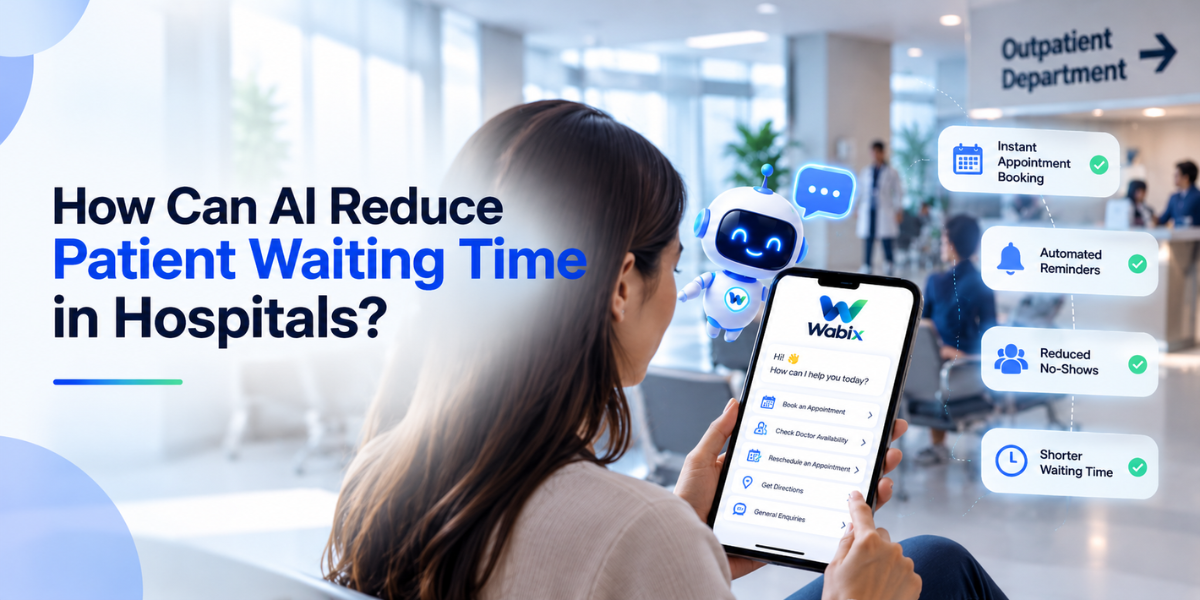
A patient may spend only a few minutes with a doctor but several times longer waiting to reach the doctor.
The queue might begin before the patient enters the hospital: finding the right department, asking about availability, booking an appointment, filling in information, waiting for confirmation and then following up again.
Not every minute of that journey requires a doctor, nurse or receptionist.
That is where AI in healthcare can make a practical difference.
The goal isn't to make AI “replace” healthcare workers. It is to remove repetitive communication and administrative work so that people can spend more time on the parts of healthcare that actually need people.
Where Does Patient Waiting Time Actually Come From?
When we talk about reducing patient waiting time, the obvious answer is usually “see more patients faster.”
But waiting happens at several different points.
Where patients wait | What causes the delay | How AI can help |
|---|---|---|
Before booking | Patients call or message to ask basic questions | AI chatbot handles FAQs |
Appointment booking | Back-and-forth with reception | Automated scheduling |
Confirmation | Staff manually confirm appointments | Instant WhatsApp confirmation |
Reminders | Patients forget or miss appointments | Automated reminders |
Registration | Repeated information collection | Digital pre-registration |
Department navigation | Patients don't know where to go | Automated instructions |
Follow-up | Staff manually contact patients | Automated follow-up messages |
Rescheduling | Cancelled slots remain unused | Automated rescheduling workflows |
This is an important distinction.
AI cannot magically make a hospital's emergency department move faster.
But it can reduce the administrative friction surrounding that care.
And sometimes, reducing that friction is enough to free up significant staff capacity.
Reminders Can Reduce More Than No-Shows
Imagine a patient books an appointment three weeks in advance.
The hospital sends no reminder.
The patient forgets.
The slot is lost.
Another patient could have used it.
Now the hospital has an empty appointment, while someone else may still be waiting for an available slot.
Appointment reminders are a relatively simple form of automation, but there is strong evidence behind them.
A systematic review and meta-analysis covering 26 studies found that patients receiving electronic notifications were 23% more likely to attend and 25% less likely to miss appointments than those receiving no notifications. Multiple notifications were also more effective than a single reminder in the reviewed evidence. PubMed
Another large-scale study found that automated appointment reminders helped clinics increase their ability to care for more patients, likely through earlier cancellations and rescheduling. PubMed
This creates an interesting connection between patient communication and waiting time.
A reminder doesn't make the doctor faster.
It helps make sure the doctor's available time is actually used.
This Is Where WhatsApp Automation Becomes Interesting
For many patients, the problem isn't that a hospital doesn't have information.
The problem is getting that information at the right moment.
This is where a platform such as Wabix can sit within the patient communication layer.
Instead of asking patients to repeatedly call a reception desk, a hospital, diagnostic centre or clinic can use WhatsApp as a communication channel for routine interactions.
For example:
Patient asks:
“I need an appointment with a cardiologist.”
The workflow can:
1. Identify the request
→ Cardiology appointment
2. Ask for relevant information
→ Preferred date / time
3. Present available options
→ Available appointment slots
4. Confirm the selection
→ Appointment details
5. Send a reminder
→ Automated WhatsApp notification
6. Handle a rescheduling request
→ Offer alternative slots
7. Escalate when necessary
→ Connect the patient to a human
The important part is not the chatbot itself.
It's the workflow behind it.
AI Should Handle the Queue. Humans Should Handle the Exceptions.
This is probably the most important principle when applying AI to healthcare communication.
Not every patient interaction should be automated.
A simple question such as:
“What time does the clinic open?”
doesn't necessarily require a receptionist.
But:
“My symptoms have suddenly become worse. What should I do?”
is completely different.
The system should recognise when an interaction falls outside its defined scope and route it appropriately.
This is where human handoff becomes essential.
The goal isn't maximum automation.
The goal is appropriate automation.
What Happens Behind the Scenes?
A well-designed AI healthcare workflow can connect several otherwise disconnected activities.
For example:
↓
AI understands the request
↓
Appointment / scheduling system
↓
Available slot
↓
Patient confirmation
↓
Automated reminder
↓
Attendance / cancellation
↓
Human escalation when required
The patient sees a simple conversation.
Behind it, there may be several systems working together.
That is the real opportunity for AI automation in healthcare.
Not just answering questions.
Connecting the workflow.
But Can AI Actually Reduce Hospital Waiting Time?
Yes. AI is more likely to reduce administrative and communication-related waiting than directly reduce clinical waiting.
Consider the difference.
Traditional journey
Patient calls
→ waits for receptionist
→ asks about availability
→ receptionist checks system
→ patient chooses slot
→ confirmation is sent manually
→ patient calls again with a question
→ staff responds
→ appointment approaches
→ reminder is sent manually
→ patient needs to reschedule
→ another call
AI-assisted journey
Patient opens WhatsApp
→ asks a question
→ receives an instant response
→ selects appointment
→ receives confirmation
→ gets automated reminder
→ requests rescheduling if necessary
→ receives available options
→ human takes over if the situation requires it
The difference isn't that AI has replaced the hospital staff.
The difference is that staff aren't required for every step.
The American Medical Association's 2025 physician survey found that 57% of physicians identified reducing administrative burdens through automation as the biggest opportunity for AI. Physicians also saw potential benefits in care coordination, patient convenience and resource allocation.
That is a useful way to frame the opportunity.
For hospitals, clinics and diagnostic centres, Wabix can be positioned not as a replacement for the healthcare team, but as a patient communication and automation layer.
Frequently Asked Questions
How can AI reduce patient waiting time in hospitals?
AI can reduce administrative waiting by automating appointment enquiries, scheduling, confirmations, reminders, rescheduling and routine patient communication. It does not directly solve clinical capacity constraints.
Can AI chatbots book hospital appointments?
Yes, when integrated with an appropriate appointment or scheduling system, a chatbot can guide patients through availability and booking workflows. Human escalation should remain available for situations outside the chatbot's defined scope.
Can WhatsApp reduce patient waiting time?
WhatsApp can reduce communication delays by allowing patients to receive information, confirmations, reminders and other routine responses through a familiar messaging channel. The effectiveness depends on how well the underlying workflow is designed.
Can AI replace hospital receptionists?
The more realistic use case is assistance rather than replacement. AI can handle repetitive enquiries and administrative workflows, allowing reception staff to focus on complex requests and patients who need human support.