

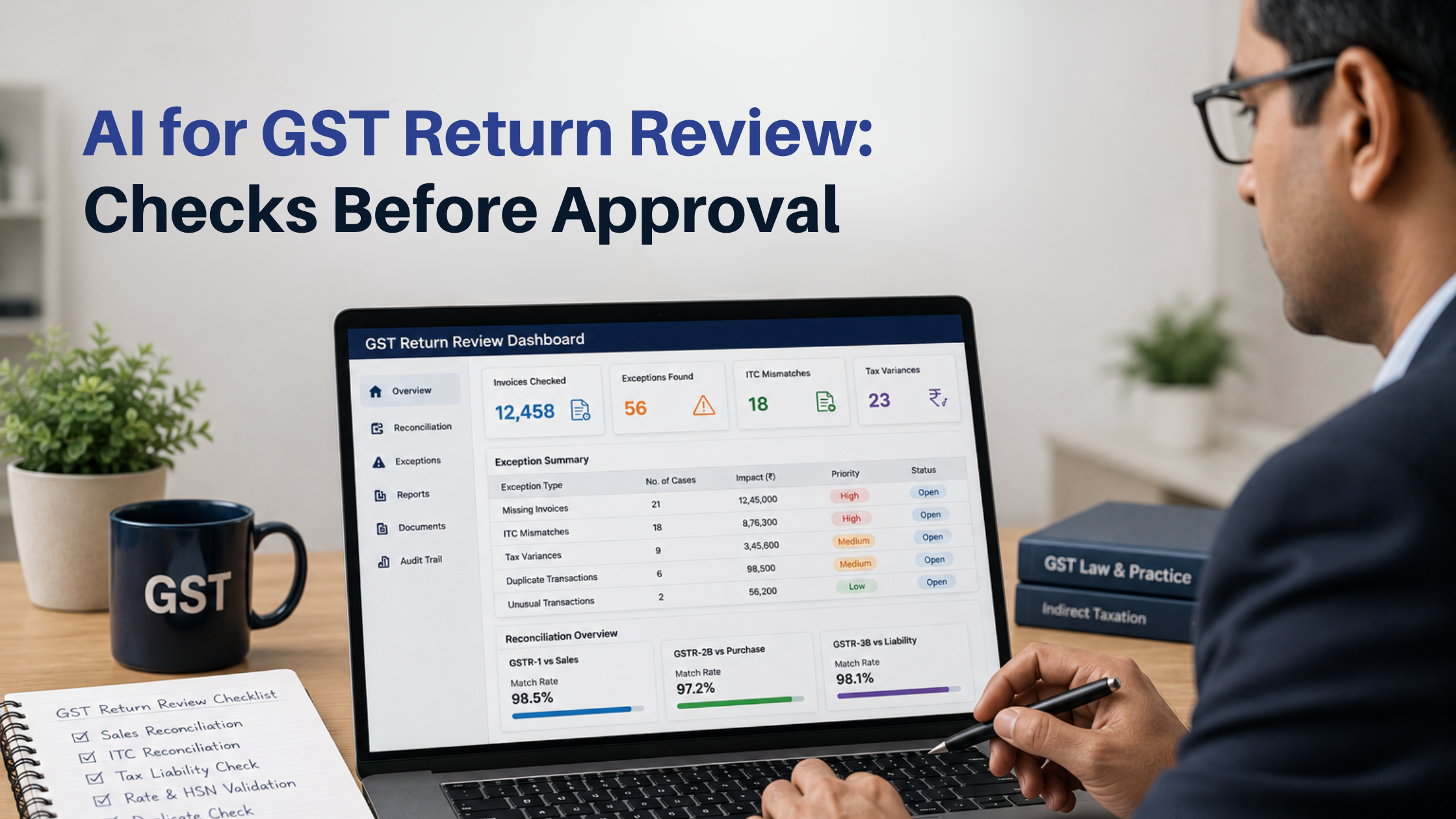
AI for GST return review can help finance and tax teams identify mismatches, unusual transactions, missing records and reconciliation exceptions before a return reaches the final approval stage. Instead of manually checking every transaction, teams can use AI and rule-based automation to focus human attention on the exceptions that actually require judgment.
The objective should not be to let AI make the final tax decision.
A stronger model is AI-assisted review with human approval: machines perform repetitive validation and reconciliation at scale, while qualified professionals investigate exceptions, make tax judgments and authorize filing.
Quick answer: Before human approval, AI can help compare GSTR-1, GSTR-2B, GSTR-3B and accounting records; identify missing or duplicate transactions; detect unusual variances; classify exceptions; and prepare a review summary. Human reviewers should remain responsible for interpreting tax treatment, validating material exceptions, approving adjustments and authorizing the final return.
Why Is GST Return Review a Good Use Case for AI?
GST return review contains a large amount of repetitive, structured and comparison-heavy work—the kind of work where automation can provide meaningful assistance.
A typical review can involve data from:
the sales register;
purchase records;
GSTR-1;
GSTR-1A where relevant;
GSTR-2B;
draft GSTR-3B;
credit and debit notes;
previous-period adjustments;
tax ledgers; and
supporting invoices or documents.
The difficulty is not simply having the data.
The challenge is comparing those datasets consistently, finding the differences and determining which differences actually require attention.
That creates an ideal division of work.
AI and automation: process large datasets, compare records, identify exceptions and organize evidence.
Human reviewer: investigate exceptions, apply GST knowledge, make judgments and approve the return.
This is more useful than attempting to replace the reviewer entirely.
GST return review can also form part of broader AI-driven financial operations, where repetitive finance processes are structured, automated and monitored while people retain control over important decisions.
What Can AI Check Before a GST Return Is Approved?
AI can act as a pre-filing control layer across several areas of GST review.
Review area | What AI/automation can check | Human role |
|---|---|---|
Sales register vs GSTR-1 | Missing, duplicate or inconsistent transactions | Validate exceptions |
GSTR-1 vs GSTR-3B | Turnover and output-tax variances | Explain/approve differences |
GSTR-2B vs purchase records | Invoice-level ITC mismatches | Determine ITC treatment |
Tax rates | Unusual or inconsistent rate application | Confirm correct classification |
GSTIN/data fields | Missing or inconsistent identifiers | Resolve source-data issues |
Credit/debit notes | Missing or unmatched adjustments | Confirm treatment |
Period comparison | Unusual month-on-month movements | Determine whether legitimate |
Duplicate transactions | Similar invoice/GSTIN/value combinations | Confirm true duplicates |
Prior-period items | Unresolved or recurring exceptions | Approve adjustment |
Return summary | High-risk exceptions and unresolved variances | Final review and approval |
The important distinction is that detecting a difference and deciding its tax treatment are not the same task.
AI can be excellent at the first.
The second may require professional judgment.

Can AI Reconcile the Sales Register With GSTR-1?
Yes. Transaction-level reconciliation is one of the most practical checks to automate before filing.
A system can compare the organization's sales data against GSTR-1 records and flag situations such as:
invoices in the books but missing from return data;
records appearing in the return but not the expected source dataset;
duplicate invoices;
GSTIN mismatches;
invoice-number differences;
taxable-value differences;
tax-amount differences;
incorrect or unusual tax rates;
credit or debit notes that do not reconcile; and
transactions appearing in different reporting periods.
Rather than giving the reviewer thousands of records, the system can separate them into categories such as:
Matched — no action appears necessary.
Probable match — small differences or formatting inconsistencies require validation.
Mismatch — material fields disagree.
Missing — transaction appears in one dataset but not the other.
High-risk exception — potentially material issue requiring immediate review.
This changes the review process from checking everything to investigating exceptions.
Can AI Compare GSTR-1 With GSTR-3B?
Yes. Comparing outward-supply information with the corresponding GSTR-3B position is another important pre-filing control.
The GST Portal itself uses information from GSTR-1/1A to generate relevant GSTR-3B values.
An AI-enabled review layer can go further by comparing source books, return data and the draft position before approval.
For example, it can ask:
Does reported turnover reconcile?
Does output tax reconcile by tax head?
Are amendments affecting the current period?
Are credit notes reflected consistently?
Are there unexplained differences between the source ledger, GSTR-1 and GSTR-3B?
Is the current variance materially different from previous periods?
Where the numbers do not agree, the system should not automatically decide that one return is "wrong."
It should produce an exception with supporting data for review.
That distinction matters because some differences may have legitimate explanations involving timing, amendments or tax treatment.
Can AI Review GSTR-2B Against Purchase Records?
Yes. AI and deterministic matching can help compare purchase records with GSTR-2B and identify ITC-related exceptions.
Possible checks include:
purchase invoice not found in GSTR-2B;
GSTR-2B entry not found in the purchase records;
GSTIN mismatch;
invoice-number mismatch;
invoice-date mismatch;
taxable-value variance;
tax-amount variance;
duplicate invoice;
credit-note mismatch; and
transactions requiring additional ITC review.
This is an especially important review area because discrepancies between ITC available in GSTR-2B and ITC claimed in GSTR-3B can have compliance consequences.
But AI should be used carefully here.
A mismatch is not automatically a conclusion about eligibility.
The system can identify the exception and assemble the relevant evidence. A qualified reviewer should determine whether ITC is available, needs to be reversed, deferred or otherwise treated under the applicable GST rules.
AI identifies the question. The tax professional answers it.
Can AI Detect Duplicate or Missing GST Transactions?
Yes. Duplicate and missing-record detection are strong candidates for automation because they depend heavily on pattern matching.
A system can compare combinations such as:
supplier/customer GSTIN;
invoice number;
invoice date;
taxable amount;
tax amount; and
document type.
Exact duplicates can be identified relatively easily.
More advanced systems can also identify near duplicates.
For example, two transactions may contain the same GSTIN, date and amount but slightly different invoice-number formatting.
Instead of silently deleting one, AI can flag the pair:
Possible duplicate — review required.
That is the safer model.
Detection can be automated. Deletion, correction or tax treatment should follow controlled approval rules.
Can AI Check GST Rates and Classification?
AI can help identify potentially unusual tax rates or classification patterns, but this is an area where human judgment becomes particularly important.
Suppose the same product or service is normally recorded at one GST rate, but a small number of transactions suddenly appear at another.
An AI system can flag the deviation.
It might say:
96% of transactions in this category use Rate A. Four transactions use Rate B. Review classification.
That is useful.
What the system should not do without appropriate controls is assume the majority rate must automatically be correct.
The minority transactions may involve a legitimate exception.
This illustrates a fundamental principle of AI-assisted GST review:
An anomaly is a signal, not a tax conclusion.
Can AI Compare the Current GST Return With Previous Periods?
Yes. Period-over-period analysis can reveal issues that transaction matching alone may miss.
AI can compare current figures with historical patterns and flag movements such as:
unexpected turnover changes;
sudden increases in ITC;
unusual changes in output-tax liability;
changes in effective tax rates;
abnormal credit-note volumes;
unusual reverse-charge movements;
recurring reconciliation differences; or
an exception that continues across multiple filing periods.
Consider a business whose sales remain relatively stable but whose ITC claim suddenly increases substantially.
That does not necessarily mean something is wrong.
But it is a good reason to ask a reviewer to investigate before filing.
The value of AI here is prioritization.
Instead of manually comparing dozens of tables, reviewers receive a shortlist of unusual movements and the underlying transactions.
How Should AI Prioritize GST Exceptions?
Not every mismatch deserves the same level of attention.
A ₹2 rounding difference and a significant unexplained ITC variance should not appear as equivalent alerts.
A useful AI review system can prioritize exceptions using factors such as:
Materiality: How large is the financial impact?
Compliance relevance: Could the issue affect tax liability, ITC or filing accuracy?
Confidence: How certain is the system that the records should match?
Recurrence: Has the same exception appeared in previous periods?
Data quality: Are key fields missing or contradictory?
Deadline impact: Does the issue need to be resolved before filing?
The resulting review queue might look like:
Critical — approval blocked
High — human review required
Medium — investigate
Low — informational
This is where AI can improve finance-team productivity substantially.
It does not remove controls.
It directs attention toward the controls that matter most.
What Should AI Not Approve on Its Own?
AI should not be given unrestricted authority over decisions requiring material tax judgment.
Examples may include:
deciding whether disputed ITC is legally eligible;
determining complex supply classification;
deciding taxability where facts are ambiguous;
interpreting unusual place-of-supply situations;
approving material unexplained variances;
deciding whether an exception can safely be ignored;
changing material tax positions without authorization; or
authorizing the final GST filing.
These decisions may depend on legislation, notifications, circulars, judicial decisions and the specific facts of the transaction.
They also create accountability.
That is why a well-designed GST AI workflow needs a clearly defined human approval boundary.
What Should the Human Reviewer See Before Approval?
The reviewer should not receive a black-box message saying:
AI reviewed the return. No problems found.
That provides very little governance value.
Instead, the final review screen should summarize what was checked and what remains unresolved.
For example:
GST Pre-Filing Review
GSTR-1 vs Sales Register
12,480 transactions checked
12,412 matched
48 probable matches
20 exceptions
GSTR-2B vs Purchase Register
4,260 transactions checked
4,201 matched
41 mismatches
18 missing records
GSTR-1 vs GSTR-3B
Turnover difference: reviewed
Output-tax difference: 2 exceptions pending
Anomaly Review
6 unusual movements identified
5 resolved
1 pending approval
Final status: HUMAN REVIEW REQUIRED
The reviewer should then be able to drill down into every material exception and see:
source record;
return record;
variance;
reason for flag;
supporting document;
suggested next action;
reviewer comment;
resolution status; and
approval history.
This creates an audit trail instead of an AI opinion.
Why Does an Audit Trail Matter for AI-Assisted GST Review?
An audit trail makes the review process explainable and accountable.
If AI is used to influence a compliance workflow, organizations should be able to answer:
What data was reviewed?
What checks were performed?
Which exceptions were detected?
Which exceptions were accepted?
Who reviewed them?
What changes were made?
Who gave final approval?
What information supported that decision?
This principle extends beyond GST.
Responsible AI systems should record meaningful actions and maintain human oversight where consequences are significant.
For GST, that means the goal is not simply faster reconciliation.
It is faster reconciliation with evidence.
What Does a Good AI-Assisted GST Review Workflow Look Like?
A practical workflow can be designed in seven stages.
1. Collect the Data
Bring together accounting records, sales data, purchase data and relevant GST return information.
2. Validate the Data
Check required fields, formats, GSTINs, invoice identifiers, tax amounts and obvious structural errors.
3. Reconcile the Records
Compare sales records with GSTR-1, purchase records with GSTR-2B and relevant GSTR-1/1A information with the draft GSTR-3B position.
4. Detect Anomalies
Identify unusual rates, amounts, duplicates, missing records, timing differences and historical deviations.
5. Score and Prioritize Exceptions
Separate minor differences from material compliance issues.
6. Route Exceptions to Humans
Send ambiguous or material cases to the appropriate finance or tax reviewer with the supporting evidence already assembled.
7. Require Final Approval
Only after the exceptions are resolved should the authorized reviewer approve the return for filing.
The architecture is therefore:
Data → Validation → Reconciliation → Exception Detection → Human Review → Approval → Filing
AI operates primarily in the middle.
Accountability remains with people.

Is AI Better Than Rule-Based GST Automation?
The strongest solution often uses both.
Many GST checks do not need generative AI.
If the requirement is:
Compare GSTIN A with GSTIN B and flag them when they differ.
A deterministic rule is appropriate.
If the requirement is:
Review this group of mismatches, recognize likely patterns, organize them by probable cause and explain which ones deserve attention first.
AI can add another layer of intelligence.
A robust GST review system can therefore combine:
Rules for predictable validations.
Reconciliation logic for transaction matching.
AI for anomaly detection, exception classification and reviewer assistance.
Humans for judgment and approval.
The goal is not to use AI everywhere.
It is to use the right level of intelligence at each point in the workflow.
This combination is also central to AI-native business systems, where AI is connected to real workflows and data rather than operating as a standalone assistant.
How Can Businesses Start Using AI for GST Return Review?
Start with the checks that are repetitive, measurable and easy to verify.
A sensible first implementation could focus on:
sales register vs GSTR-1 reconciliation;
purchase register vs GSTR-2B matching;
GSTR-1/1A vs draft GSTR-3B comparison;
duplicate and missing-invoice detection;
material variance alerts; and
a human approval dashboard.
Once these checks are reliable, more advanced anomaly detection and exception explanations can be introduced.
Businesses should also define governance from the beginning.
Who can access GST data?
Which actions can AI recommend?
Which actions can automation execute?
What requires human approval?
How are decisions logged?
What happens when the system is uncertain?
Those questions are as important as the matching algorithm itself.
AI Should Make GST Review More Controlled, Not Less Human
The biggest opportunity for AI in GST return review is not autonomous filing.
It is better pre-filing control.
AI can process thousands of transactions, compare multiple datasets, find inconsistencies, identify anomalies and organize exceptions far faster than a reviewer working line by line.
But speed should not eliminate judgment.
The strongest model is a controlled workflow where automation handles repetitive checks, AI helps identify and explain exceptions, and qualified professionals retain authority over tax decisions and final approval.
For finance teams, that changes GST review from a monthly search for errors into a structured exception-management process.
AI checks. Humans judge. The organization retains control.