

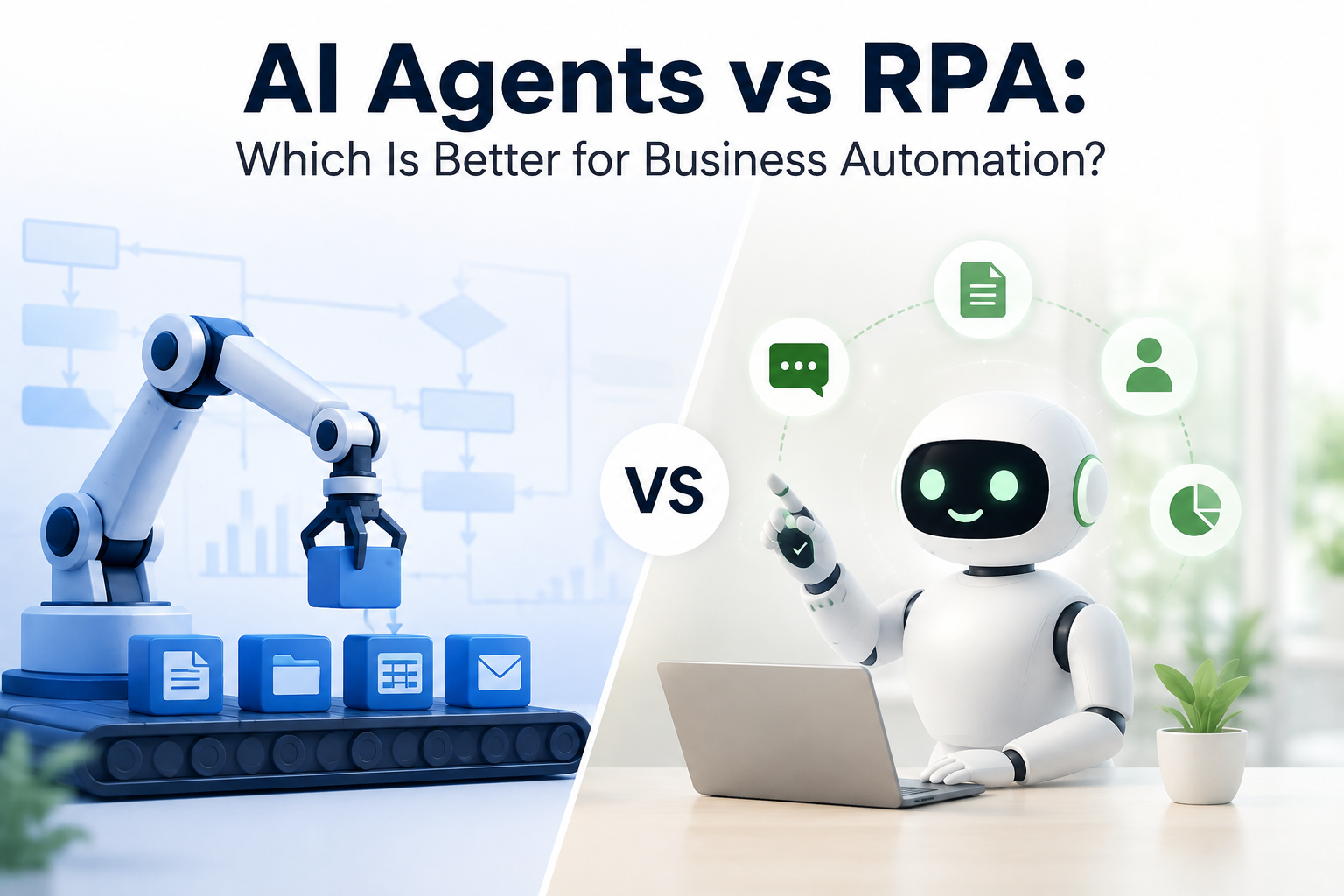
Business automation is changing. For years, robotic process automation (RPA) has helped organizations reduce repetitive manual work by automating predictable, rules-based tasks. Now, AI agents are introducing a different approach - systems that can interpret information, make context-aware decisions, use tools, and take action toward a defined goal.
This raises an important question for business leaders: AI agents vs RPA - which is better for business automation?
The answer depends on the process.
RPA remains highly effective for repetitive, structured, and predictable tasks. AI agents are better suited to workflows involving unstructured information, changing conditions, exceptions, and decisions. And in many organizations, the strongest approach may be combining both.
Quick Answer: AI Agents vs RPA
RPA follows predefined instructions, while AI agents work toward defined objectives.
RPA is generally better for stable, repetitive processes where the rules and sequence of actions are known in advance. AI agents are better when automation requires understanding context, processing unstructured information, deciding what to do next, or coordinating actions across multiple systems.
For more complex business operations, organizations can also combine AI agents with deterministic automation such as RPA, APIs, and traditional workflows.
What Is Robotic Process Automation (RPA)?
Robotic process automation uses software bots to perform repetitive digital tasks according to predefined rules and workflows.
An RPA bot can imitate many of the actions an employee performs on a computer, including:
copying information between applications,
entering data into forms,
downloading or moving files,
generating routine reports,
updating records, and
performing repetitive administrative tasks.
Imagine an employee who performs the same process every morning:
Open a spreadsheet.
Copy a customer number.
Open another application.
Search for the customer.
Enter information into a form.
Save the record.
Repeat for the next customer.
If the process follows the same steps consistently, an RPA bot can execute much of that work automatically.
This makes RPA particularly useful when a process is structured, repetitive, stable, and predictable.
The challenge appears when the process requires interpretation.
If an unexpected document arrives, the information is presented differently, the workflow changes, or a situation requires judgment, traditional rule-based automation may require another rule, exception path, or human intervention.
What Is an AI Agent?
An AI agent is a software system designed to work toward an objective by interpreting information, determining what actions to take, and interacting with tools or systems.
Instead of defining every possible step in advance, organizations can provide an AI agent with an objective, relevant business context, access to approved tools, and clear operational boundaries.
Consider a customer who sends this message:
"We received the wrong quantity on yesterday's shipment. Can you check what happened and tell us when the remaining units will arrive?"
A traditional automation workflow would need predefined rules for identifying the request and determining what happens next.
An appropriately designed AI agent could potentially:
understand what the customer is asking,
identify the customer and relevant order,
retrieve shipment information,
compare ordered and delivered quantities,
review applicable business policies,
determine the appropriate next action,
draft a response,
update a support or CRM record, and
escalate the case when it falls outside its authority.
The important distinction is not simply that an AI agent can generate text.
Its real value comes from combining understanding with action.
This represents a broader shift from automation that follows instructions toward intelligent systems that can operate within defined business processes.
What Is the Difference Between AI Agents and RPA?
The biggest difference between AI agents and RPA is how they determine what happens next.
RPA generally executes a predefined sequence. An AI agent can evaluate available context and determine an appropriate next action within its permitted boundaries.
Capability | RPA | AI Agents |
Operating model | Follows predefined rules | Works toward defined objectives |
Decision-making | Rule-based | Context-aware |
Best input | Structured data | Structured and unstructured data |
Adaptability | Limited | Higher |
Exceptions | Usually predefined | Can interpret variable situations |
Natural language | Limited without additional AI | Core capability for many agents |
Predictability | High for stable processes | Requires additional controls |
Legacy UI automation | Strong use case | Depends on integrations and tools |
Multi-system coordination | Possible | Strong use case |
Best suited for | Repetitive tasks | Dynamic workflows |
These differences explain why one technology is not automatically better than the other.
The right choice depends on the characteristics of the business process.
When Is RPA Better Than AI Agents?
RPA is often the better choice when a process is stable, repetitive, rules-based, and requires consistent execution.
Typical RPA use cases can include:
transferring structured information between systems,
filling standardized forms,
generating scheduled reports,
downloading and renaming files,
performing repetitive data-entry sequences,
executing predictable reconciliation tasks, and
interacting with legacy applications where suitable APIs are unavailable.
For these processes, adding AI may create unnecessary complexity.
If a workflow has five clearly defined steps and those steps rarely change, the organization may not need a system that reasons about what to do next.
It simply needs reliable execution.
This leads to an important automation principle:
Do not introduce more intelligence than the process requires.
The goal of business automation should not be to use the newest technology. It should be to create the simplest reliable system capable of producing the required outcome.
When Are AI Agents Better Than RPA?
AI agents become more valuable when a workflow cannot easily be reduced to a predictable sequence of rules.
Several characteristics can indicate that a process is a stronger candidate for agentic automation.
The Process Involves Unstructured Information
Businesses operate on far more than database fields.
Employees work with:
emails,
contracts,
reports,
PDFs,
meeting notes,
policies,
support conversations, and
other forms of unstructured information.
AI agents can interpret this information and use it as context when deciding what should happen next.
The Workflow Changes Depending on the Situation
Some business processes have a clear objective but not a fixed path.
For example, resolving a customer issue might require checking an order system in one case, reviewing a policy document in another, and escalating to a specialist in a third.
Trying to define every possible scenario through fixed rules can quickly create complicated automation.
An AI agent can instead evaluate the situation and select among approved actions.
Decisions Depend on Context
Many operational processes involve questions such as:
Is this request urgent?
Which policy applies?
Is important information missing?
Does this action require approval?
Which department should handle the request?
Is this situation unusual enough to escalate?
These decisions can become difficult to manage through increasingly large sets of if/then rules.
The Process Spans Multiple Systems
AI agents can also coordinate activities across approved business tools and data sources.
An agent might retrieve information from one system, consult internal knowledge from another, determine the next step, and initiate an action through a third.
This changes the automation model from:
"Repeat these steps."
to:
"Achieve this operational objective within these boundaries."
Will AI Agents Replace RPA?
AI agents are unlikely to eliminate RPA completely.
There will continue to be business processes where deterministic automation is the most practical approach, particularly when tasks are predictable or organizations depend on legacy systems.
Instead, AI agents are likely to change how businesses architect automation.
Rather than forcing one technology to handle an entire process, organizations can separate intelligence from execution.
Consider invoice processing.
Deterministic automation could:
retrieve invoices,
move validated records,
enter approved information into a legacy system, and
archive completed transactions.
An AI agent could potentially handle more variable tasks such as:
interpreting invoice information,
reviewing relevant context,
identifying anomalies,
determining which approved workflow applies, and
escalating ambiguous situations.
The architecture could look like this:
Business Input → AI Interpretation → Decision → Deterministic Execution → Validation → Human Exception Handling
The more useful question therefore becomes:
Which parts of this process require intelligence, and which simply require reliable execution?
Can AI Agents and RPA Work Together?
Yes. AI agents and RPA can complement each other.
This can be particularly valuable for organizations that want more intelligent automation but still rely on legacy applications and existing RPA investments.
A hybrid automation architecture can be understood as three layers.
1. Intelligence Layer
The AI agent interprets:
objectives,
requests,
documents,
business context,
policies, and
previous interactions.
2. Decision and Orchestration Layer
The system determines:
what needs to happen,
which tool should be used,
whether approval is required,
what should happen next, and
when a human should become involved.
3. Execution Layer
APIs, workflows, RPA bots, and other automation components execute approved actions.
This approach allows organizations to preserve useful automation investments while introducing intelligence where it creates genuine operational value.
AI Agents vs RPA: A Practical Business Example
Consider a company processing supplier invoices.
An RPA-Driven Approach
An RPA bot might:
Open an invoice from a known location.
Extract predefined information.
Enter the data into an ERP system.
Run predefined checks.
Route exceptions to an employee.
This can work extremely well when invoices and processes are predictable.
But suppose a supplier sends an email saying:
"This invoice replaces the previous invoice because the contract pricing changed after the last shipment."
The process now requires context.
Which invoice is being replaced?
Which contract applies?
Was the pricing change approved?
Does finance need to review it?
Trying to address every possible situation by continuously adding more rules can make the automation increasingly complex.
An Agent-Enabled Approach
An AI agent could interpret the supplier's message, retrieve relevant records and approved knowledge, identify the issue, and determine which workflow should run next.
The final transaction could still be performed through an API, traditional workflow, or RPA bot.
The AI agent does not necessarily replace the existing automation.
It adds intelligence to the part of the process where intelligence is needed.
What Are the Risks of Using AI Agents for Business Automation?
AI agents introduce new capabilities, but those capabilities require appropriate governance and controls.
Unlike traditional rules-based automation, AI-driven systems can be probabilistic. Organizations therefore need to consider risks such as:
incorrect outputs,
inappropriate actions,
excessive system permissions,
sensitive-data exposure,
inadequate escalation rules,
insufficient monitoring,
weak audit trails, and
inadequate human oversight.
The level of control should reflect the consequences of the action.
For example, an AI agent that recommends a refund presents a different level of risk from an agent that can issue a refund without approval.
Similarly, an agent that summarizes a contract has a different risk profile from one authorized to change contractual records.
Effective agentic automation therefore requires more than connecting an AI model to business applications.
Organizations need clear boundaries around:
what the agent can access, what it can decide, what actions it can perform, when approval is required, and when responsibility must return to a human.
How Should Businesses Choose Between AI Agents and RPA?
Start with the workflow, not the technology.
Before choosing RPA, AI agents, or a hybrid approach, evaluate the process itself.
1. Is the Process Predictable?
If virtually every case follows the same path, deterministic automation may be sufficient.
2. Are the Inputs Structured?
Structured database fields and standardized forms favor conventional automation.
Emails, contracts, documents, conversations, and other unstructured information increase the potential value of AI.
3. Does the Process Require Judgment?
If decisions depend on context rather than fixed rules, an AI agent may be more appropriate.
4. How Often Do Exceptions Occur?
A process with frequent exceptions can become increasingly difficult to maintain through large rule trees.
5. Which Systems Must Be Used?
Legacy applications without APIs may still make RPA valuable, even within a broader agentic system.
6. What Happens If the Automation Is Wrong?
Higher-risk decisions require stronger controls and may require human approval regardless of the underlying technology.
7. Does the Process Change Frequently?
If operating conditions, inputs, or required actions change regularly, an agentic architecture may provide greater flexibility than a rigid workflow.
A practical rule of thumb is:
Use deterministic automation where the path is known. Add intelligence where the path depends on context. Keep humans involved where consequences require judgment or accountability.
AI Agents vs RPA: Which Is Better for Your Business?
RPA is better for predictable execution. AI agents are better for context-driven work. A hybrid approach can be better when a business process requires both intelligence and deterministic reliability.
The goal should not be to replace RPA simply because AI agents are newer.
Instead, map the business process first.
Ask:
What work is repetitive?
What requires context?
What requires judgment?
What can be handled through APIs?
What still depends on legacy systems?
Where do exceptions occur?
Where must a person remain accountable?
Once those boundaries are understood, choosing the right automation architecture becomes much easier.
The future of business automation is unlikely to be one technology replacing every other technology. It is more likely to involve intelligent operational systems in which APIs connect applications, deterministic workflows execute predictable logic, RPA bridges legacy interfaces, AI agents coordinate context-dependent work, and humans provide oversight where it matters.
At IrizPro, we design AI systems around real business processes—not AI for AI's sake. Our AI Engineering approach combines intelligent workflows, agentic systems, custom AI solutions, and system integrations to help organizations move from fragmented automation toward connected, intelligent operations.
Ready to explore where AI agents could create value in your operations?
Talk to IrizPro about your workflows, existing automation, and AI opportunities.