

For more than two decades, ecommerce has been built around one basic assumption:
A person will visit a website, find a product, add it to a cart, and complete the purchase.
Almost everything we have built around online shopping reflects that assumption.
Search bars are designed for people.
Product pages are designed for people.
Navigation menus are designed for people.
Checkout flows are designed for people.
But what happens when the next customer doesn't do any of that?
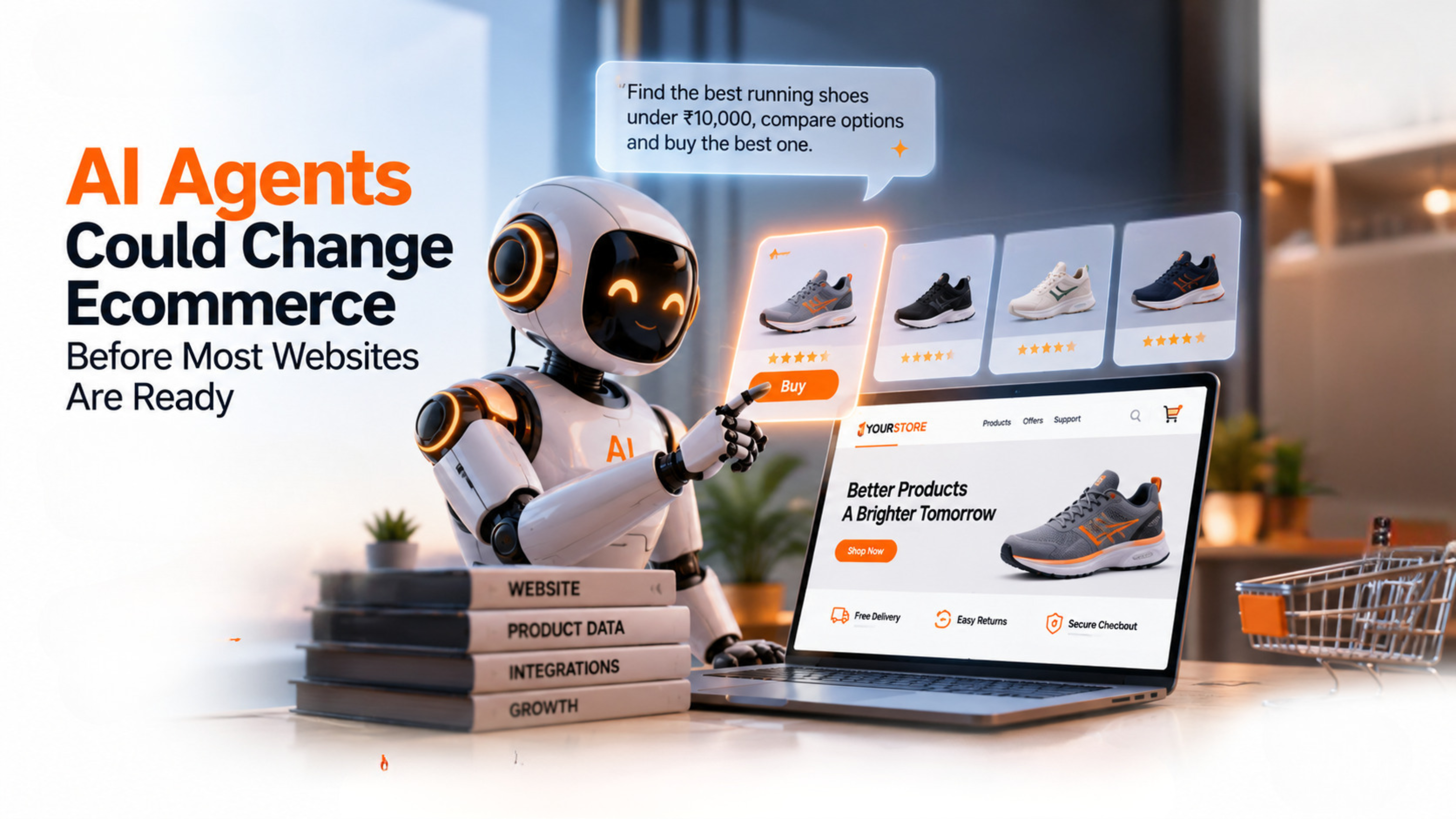
What happens when the customer says to an AI agent:
“Find me a good laptop under $1,000, compare the best options, and buy the one that meets my requirements.”
The customer may never visit the retailer's homepage.
The AI agent may do the searching, comparing, filtering and, increasingly, even the purchasing.
That is the idea behind agentic commerce — and it is moving from an interesting AI concept toward something ecommerce businesses need to start preparing for.
Google has introduced infrastructure such as the Universal Commerce Protocol (UCP) and Universal Cart to support AI-assisted shopping, while Shopify is building ways for merchants to make their products available across AI shopping experiences. (blog.google)
The interesting question is no longer whether AI will influence ecommerce.
It is:
Are ecommerce websites ready for customers who arrive through an AI agent rather than a browser?
The Website Visit Is Being Replaced by the Request
The traditional ecommerce journey looks something like this:
Search → Website → Product page → Comparison → Cart → Checkout
The emerging agentic journey could look very different:
Request → AI agent → Product discovery → Comparison → Recommendation → Purchase
The difference is subtle but significant.
In the traditional model, the website is the place where the customer makes decisions.
In an agentic model, the AI may make much of the decision-making process before the customer ever reaches the website.
Imagine someone looking for running shoes.
Instead of searching Google, opening five websites and comparing prices, they might ask an AI assistant:
“Find me running shoes for daily road running, under ₹10,000, with good cushioning, available in my size.”
The agent could potentially compare products, prices, specifications, availability and delivery information, then present a shortlist.
The website has not disappeared.
But its role has changed.
AI Agents Don't Browse Websites Like Humans
This is where the problem becomes interesting for website development.
A human can look at a beautifully designed product page and understand what is important.
They can see the product image.
They can read the headline.
They can understand that “Free delivery” is an important selling point.
They can interpret a size chart.
An AI agent needs much more structured information.
It needs to reliably understand:
What exactly is the product?
What variants are available?
What does it cost?
Is it in stock?
What are its specifications?
What are the delivery conditions?
Can it be returned?
What alternatives exist?
Can the product actually be purchased?
A website can look fantastic and still be difficult for an AI system to interpret reliably.
That creates a new development challenge.
The website now needs to communicate with two audiences: humans and machines.
Product Data May Become More Important Than Product Pages
For years, ecommerce companies have invested heavily in product-page design.
High-resolution images.
Better typography.
Reviews.
Videos.
Comparison tables.
Personalised recommendations.
All of these remain important for humans.
But AI shopping agents also need clean and reliable product data.
Google's UCP updates, for example, include capabilities that allow shopping agents to retrieve information such as real-time pricing and inventory from retailer catalogues. Shopify is similarly building structured commerce infrastructure that allows product information to be surfaced across AI channels. (blog.google)
This points to an important shift:
An ecommerce website is increasingly becoming a data system as well as a visual experience.
The product page is what the customer sees.
The underlying product information is what the agent needs to understand.
A Beautiful Website Is No Longer Enough
This does not mean website design is becoming less important.
It means the definition of a good website is becoming broader.
Consider two ecommerce websites.
Website A
It looks beautiful.
The product images are excellent.
But:
Product specifications are inconsistent.
Prices aren't structured clearly.
Inventory information is difficult to access.
Product variants are poorly defined.
Shipping information is buried.
Product descriptions contain vague marketing language.
Website B
It looks equally good, but underneath:
Product attributes are structured.
Pricing is consistent.
Inventory is current.
Variants are clearly defined.
Policies are accessible.
Product information is machine-readable.
Commerce actions are properly connected.
For a human, both might look excellent.
For an AI shopping agent, they could be very different.
That is why AI-ready website development is becoming a much more interesting concept.
The Search Result Could Become the Shopping Experience
Search itself is also changing.
Google says its AI Mode is moving toward more agentic experiences, with AI agents helping users accomplish tasks rather than simply returning a list of links. Google has also introduced shopping infrastructure designed to support agentic commerce. (blog.google)
That creates a difficult question for traditional SEO.
For years, businesses optimised pages to get the user to click.
But if an AI system reads several sources, compares them and gives the user an answer directly, the click may no longer be the only measure of visibility.
A business could be discovered without receiving the traditional search visit.
The AI might say:
“Here are three products that match what you're looking for.”
The consumer may then interact with the recommendation rather than browsing through ten search results.
This makes AI search visibility increasingly important alongside conventional SEO.
The New Ecommerce Funnel Could Look Very Different
Traditional Ecommerce | Agentic Commerce |
|---|---|
User searches | User describes intent |
User opens websites | AI searches multiple sources |
User compares products | AI compares products |
User reads specifications | AI interprets specifications |
User decides | AI helps narrow the decision |
User adds to cart | Agent may initiate purchase |
User checks out | Agent-assisted checkout |
The important point is that this transition will not happen overnight.
Today's AI shopping systems still have limitations around reliability, permissions, payments, data access and merchant integration.
But the infrastructure is being built now.
Google is developing UCP and payment infrastructure for agentic commerce. Shopify is making products available across AI channels. And financial companies are developing systems that allow AI agents to make authorised purchases. (blog.google)
So businesses don't necessarily need to rebuild everything tomorrow.
They do need to understand where their websites are heading.
And Then There Is the Amazon Problem
One of the clearest signs that agentic commerce is still being figured out came this week.
Meta's AI shopping agent, Muse, has been blocked by Amazon from accessing Amazon's platform to make purchases. Amazon cited concerns around how the third-party agent interacted with its service and its rules. (Axios)
At almost the same time, Shopify announced a partnership to support agentic checkout through Meta's Muse using Shop Pay. (The Wall Street Journal)
These two approaches reveal an important tension.
Some platforms may want AI agents to become a new distribution channel.
Others may want to retain control over the customer relationship, data and purchasing experience.
That debate will shape the architecture of agentic commerce.
And it means businesses cannot simply assume that “AI agent access” will work the same way everywhere.
What Should Ecommerce Businesses Actually Prepare For?
The answer is not necessarily “build an AI chatbot.”
That would miss the bigger change.
The first step is making the existing digital foundation better.
1. Clean product information
Your product catalogue needs consistent:
Names
Descriptions
Specifications
Variants
Prices
Availability
Images
Categories
2. Structured data
Important information should be understandable not only to users and search engines, but increasingly to AI systems and commerce infrastructure.
3. Reliable inventory
If an AI agent recommends a product that is actually unavailable, the experience breaks.
Real-time or reliable inventory information becomes increasingly important.
4. Clear policies
Shipping, returns, refunds, warranties and other policies need to be easy to interpret.
5. Strong commerce infrastructure
The AI can discover the product, but eventually something has to handle:
Identity → Cart → Payment → Fraud → Order → Fulfilment
This is where ecommerce infrastructure becomes critical.
Websites and WhatsApp May Start Working Together Differently Too
This shift isn't limited to ecommerce websites.
The same thing is happening in conversational commerce.
A customer might discover a product through search, an AI assistant or a social platform and then move into a conversation with the business.
That conversation could happen through WhatsApp.
Instead of:
Website → Contact form → Wait for response
the journey could become:
AI/Search → Website/Product → WhatsApp → Qualification → Human/AI assistance → Purchase
This is where businesses need to think beyond individual channels.
A website should not exist in isolation from WhatsApp.
The customer shouldn't have to start from zero when they move from one channel to another.
For businesses already using WhatsApp for enquiries and sales, this is where platforms such as Wabix can become relevant: the objective is not simply to automate messages, but to connect conversations, customer information, qualification, routing and human follow-up into one operational workflow.
The New Website May Need to Serve Three Audiences
This is perhaps the most important shift.
Historically, websites were designed primarily for:
Humans.
Then SEO made businesses think about:
Search engines.
Now we increasingly need to think about:
AI agents.
Audience | What They Need |
|---|---|
Human | Design, trust, clarity, experience |
Search engine | Crawlable, relevant, structured content |
AI agent | Accurate data, context, actions, permissions |
The strongest websites will not choose one over the others.
They will be designed for all three.
The Website May Become the Backend for an AI Shopping Experience
This is where website development becomes much more interesting.
A website is no longer necessarily the final destination.
It can become the source of truth that feeds multiple experiences:
Website
↓
Product catalogue
↓
Search
AI assistants
Marketplaces
Shopping agents
Human customers
This is a very different approach to website development.
Instead of asking:
“How should our homepage look?”
Businesses may increasingly need to ask:
“How should our digital commerce system make our business understandable and actionable everywhere?”
Final Thought
The ecommerce website of the future may still look remarkably familiar.
There will still be product images.
There will still be shopping carts.
There will still be checkout pages.
But behind that familiar interface, something fundamental may have changed.
The next customer interacting with your website may not be a person.
It may be an AI agent acting on behalf of one.
And businesses that start preparing their websites for that reality now may have a very different digital foundation when agentic commerce becomes mainstream.
The question is no longer just whether your website is ready for customers.
Is it ready for the agents bringing them?